Understanding Antennas for Shortwave Listening:
A Practical Guide for DXers
# From basic antenna principles to practical SW reception | Antenna Guide Series

Many listeners spend months choosing a receiver. Then they use only the telescopic whip that came with it. This is understandable, but it limits the radio badly. A modest portable radio with a properly installed wire shortwave antenna can often beat an expensive receiver on its whip. The wire is longer. It sits higher. It is away from the radio and from your body.
This article explains the ideas behind every antenna in this series. We will keep the language simple. We will also keep the technical points correct. Later articles will build on these ideas, so it is worth reading this one slowly.
What an antenna actually does
A radio wave is an electric and magnetic field moving through space. When it passes a piece of metal, it pushes a tiny alternating current into that metal. That metal is your antenna.
The current travels along the feedline to the receiver. The receiver selects one frequency and amplifies it. Everything the receiver does starts with that tiny current.
A transmitting antenna does the reverse. It takes current from a transmitter and launches a wave into space. The same piece of wire can do both jobs.
Transmitting and receiving antennas
A passive antenna works the same way in both directions. Engineers call this reciprocity. A dipole that radiates well in one direction also receives well from that direction.
But the goals are different. A transmitting station wants to send out as much power as possible. Efficiency is very important there.
A receiving station has a different problem. On the lower shortwave bands, natural and man-made noise is strong. Your antenna collects signal and noise together. So the real question is how strong the signal is compared with the noise.
This is why a short or inefficient antenna can still work well for listening. It would be a poor transmitting antenna. But the noise it picks up is reduced along with the signal, so the ratio can still be good.
In this series, we explain transmitting antennas only where they help understanding. Our focus is the receiving antenna and practical shortwave listening.
Frequency and wavelength
Radio waves travel at about 300,000 kilometers per second. Wavelength and frequency are linked by a simple rule.
Wavelength in meters = 300 divided by frequency in MHz
This gives us the familiar band
names.
A signal at 6
MHz has a wavelength of about 50 meters. That is the 49-meter band.
And a signal at
15 MHz is about 20 meters.
A signal at 9.7 MHz is about 31 meters.
Why does this matter? Antennas
work best when their size is a useful fraction of the wavelength. A half-wave
dipole, for example, is about half a wavelength long. In practice, you cut it a
little shorter than the free-space value because of end effects and wire
thickness.
A common rule of thumb for the length of a half-wave dipole in meters is 143 divided by frequency in MHz. Treat this as a starting point. The final length depends on height, surroundings, and wire.
Quick summary

Resonance

An antenna is resonant when its electrical reactance cancels out at the operating frequency. At that point, it behaves like a simple resistance. Energy transfers to the feedline most easily.
A resonant antenna is excellent for one band. But shortwave listeners tune across many bands. A dipole cut for 49 meters will not be resonant to 19 meters.
For listening, resonance is helpful but not essential. Receivers cope with mismatches much better than transmitters do. Many good listening antennas are long non-resonant wires. We will explore them in Outdoor Receiving Antennas for Shortwave Listening (Article 2).
Polarization
Polarization describes the direction of the electric field of the wave. A vertical wire receives vertical polarization best. A horizontal wire receives horizontal polarization best.
On shortwave, most long-distance signals travel by bouncing from the ionosphere. This process twists the polarization in unpredictable ways. So polarization is less critical for distant shortwave reception than many beginners think.
For local and ground wave signals, polarization matters more. On medium wave, a vertical antenna is usually the natural choice for the local ground wave.
Radiation and reception patterns
No antenna listens equally in all directions. The pattern shows where it is most sensitive.
|
Antenna type |
Typical pattern |
|
Vertical wire |
Roughly equal in all horizontal directions |
|
Horizontal half-wave dipole |
Figure of eight. Best broadside to the wire. Weak off the
ends. |
|
Long wire |
Complex pattern with several lobes. It changes with
frequency. |
|
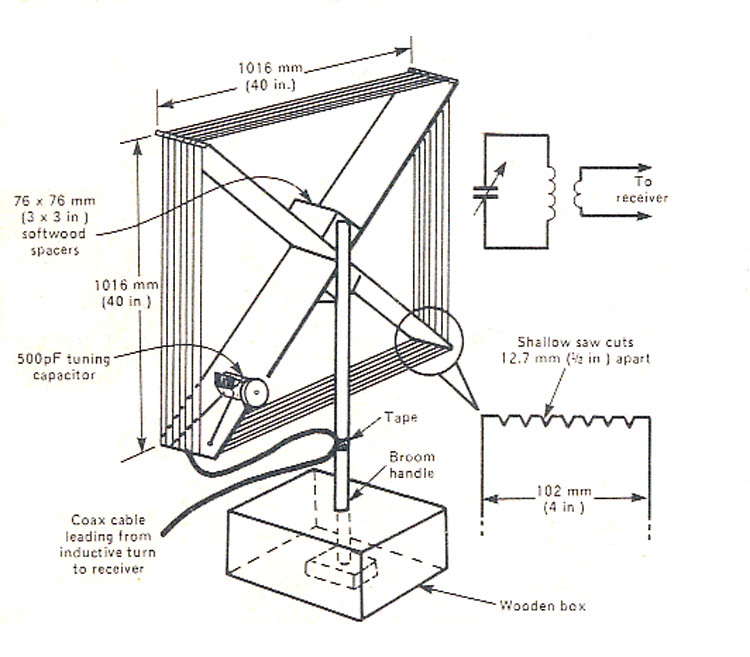
Small magnetic loop |
Figure of eight. Best along the plane of the loop. Deep
nulls broadside to it. |
The nulls of a small loop are useful. You can rotate the loop to reduce a local noise source or an unwanted station. This is one reason loops are popular with medium wave DXers.
Height also changes the pattern. A horizontal antenna low to the ground tends to favor high-angle signals. Raising it generally lowers the angle of best reception. We will discuss practical heights in Outdoor Receiving Antennas for Shortwave Listening (Article 2).

Impedance
Impedance is the opposition an
antenna presents to the signal. It includes resistance and reactance. It is
measured in ohms.
Most modern receivers and coaxial cables are designed for 50 ohms. A half-wave dipole in free space has a feed point impedance of about 73 ohms. Close to the ground, it can differ noticeably.
A long random wire can have a very different impedance. It can also change with frequency. This is why simple wire antennas often use a matching transformer, called a Unun. Antenna Accessories Every DXer Should Understand (Article 4) explains this in detail.
For a receiver, a moderate mismatch causes some signal loss. If the signal is already above the noise, this loss often does not matter. If the antenna is very short, the loss can matter more.
Bandwidth
Bandwidth here means the range of frequencies over which the antenna performs acceptably. The resonant dipole is fairly narrow. A long wire or a wideband active antenna covers a much wider range.
There is a trade-off. A narrow antenna can be very good on its design band. A wide antenna is convenient but may be less ideal on any single band.
Do not confuse antenna bandwidth with receiver bandwidth. The receiver filter, such as 6 kHz for AM, is a separate matter.
Antenna efficiency and signal-to-noise
ratio
Efficiency is the share of power
an antenna converts into a useful signal rather than heat. It matters greatly
when transmitting.
For receiving, the picture is different. Below about 15 MHz, external noise is usually stronger than a receiver’s own noise. A larger antenna may pick up more signal, but it also picks up more noise, so the signal-to-noise ratio changes little.
Above about 20 MHz, external noise is generally lower. In this range, a larger or more efficient antenna can make a greater difference.
So the key question for a DXer isn’t, “How strong is this antenna?” It’s, “Can I hear the weak station clearly above the background noise?”
Why the telescopic whip disappoints
A telescopic whip is a short vertical element. It sits right on the radio. This causes several problems.
- It is short compared with the wavelength on most shortwave bands.
- It is close to the receiver circuits, which can radiate noise.
- Also, it is close to your body and to the room, which absorbs and distorts signals.
- It is often indoors, surrounded by wiring, chargers and screens.A wire moved away from the radio and the house usually brings an immediate improvement. This is one of the cheapest upgrades in the hobby.
The antenna system, not only the wire
The antenna is only part of a chain. The chain includes the wire, the feedline, any matching device, the connectors and the receiver input. Any weak link lowers the result.
Noise can also enter through the feedline and the mains wiring. This is why a good installation keeps the antenna away from noise sources. Articles 4 and 5 will deal with these topics.
Advantages and limitations of the ideas in this article
|
Idea |
Advantage |
Limitation |
|
Resonant antenna |
Efficient on its design band |
Narrow coverage |
|
Non-resonant long wire |
Covers many bands |
Needs matching. Pattern is complex. |
|
Small loop |
Directional nulls reduce noise |
Lower signal level. Needs care in construction. |
|
Vertical |
Simple. Covers all directions. |
Can pick up more local noise |
Safety
Safety is not optional, even for receiving antennas.
- Keep every antenna wire far away from power lines. Contact can be fatal. A falling wire can also touch a line.
- Never install an antenna near overhead mains cables or service drops.
- Do not use an antenna during a thunderstorm. Disconnect it and move it away from the receiver when storms approach.
- Wear eye protection when working with wire and tools. Use a stable ladder and a helper when working at height.
- Check local rules and the permission of the building owner.
Grounding and lightning protection are covered in Antenna Accessories Every DXer Should Understand (Article 4).
DXers Note
Conclusion
An antenna is a collector of radio energy, and the DXer's goal is a clear signal above the noise. Wavelength sets the size. Patterns, polarization and height shape the result. Impedance and matching decide how well the signal reaches the receiver.
With these ideas, the next articles become easy to follow. In Article 2, we will build practical outdoor receiving antennas.

#S21TS Antenna Guide
A Practical Guide for Radio Hobbyist
Many listeners spend months choosing a receiver. Then they use only the telescopic whip that came with it. This is understandable, but it limits the radio badly.
Articles explain the ideas behind every antenna in this series.
How to choose, build and install them

Antenna for apartment and urban listeners
The parts around the antenna

antenna positioning and practical experiments

A practical project: the active loop

Understanding the design and construction