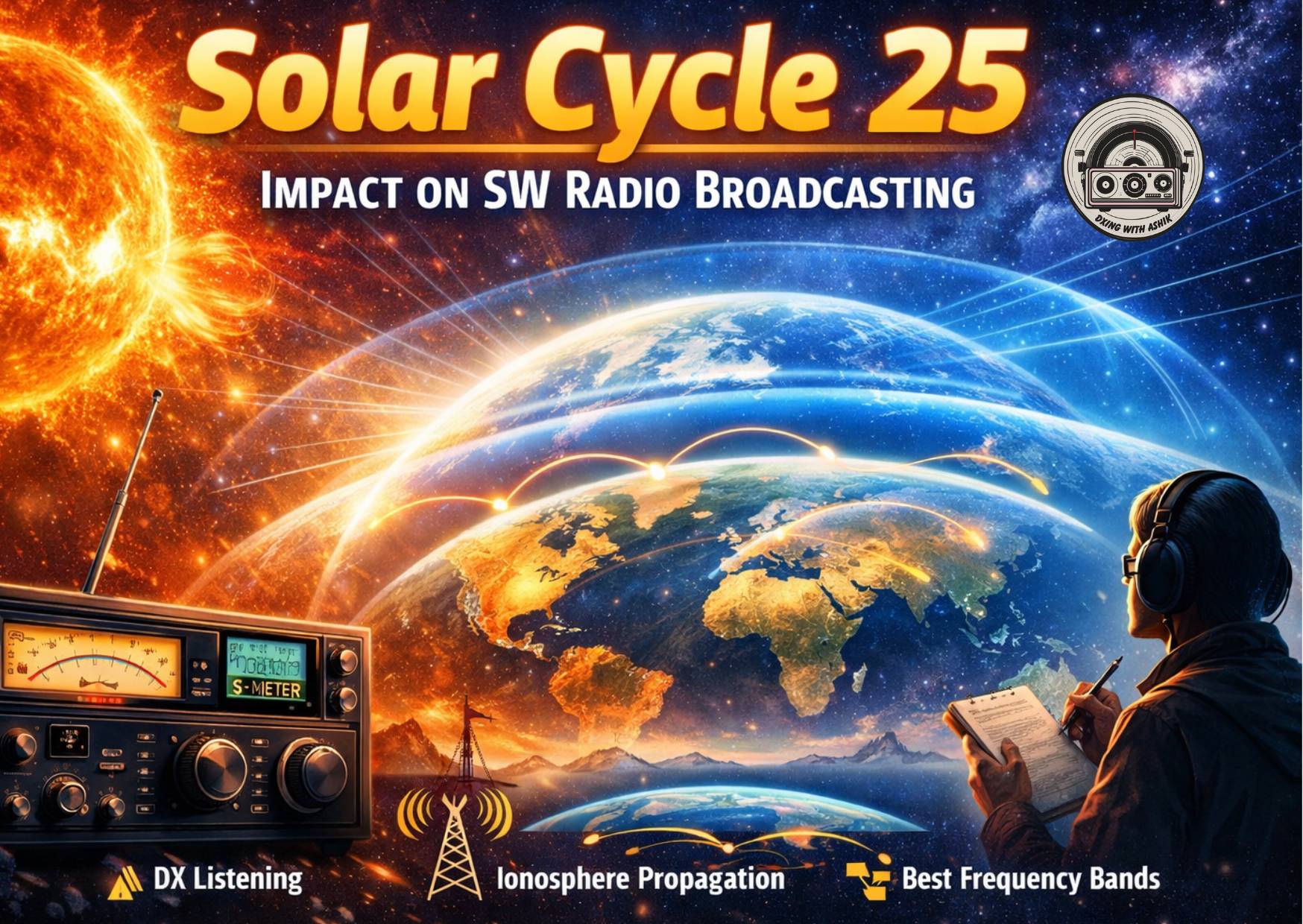

Shortwave radio (SW) signals travel thousands of kilometers by bouncing off the ionosphere. The ionosphere’s state changes with solar activity. Solar Cycle 25 has a strong influence on the quality of propagation, especially for long-distance (DX) reception.
🌞 What Is Solar Cycle 25?
Solar Cycle boosts ionospheric ionization, enhancing long-distance shortwave (SW) propagation, particularly on higher HF bands like 15m, 12m, and 10m during daytime. This benefits SW broadcasting by enabling reliable DX signals over thousands of kilometers with modest power. However, solar flares and geomagnetic storms can cause temporary blackouts. As activity declines post-peak into 2026, lower bands (20m-40m) become more consistent at night, while higher frequencies fade.
Solar Cycle 25 is the current 11-year cycle of solar activity, which began in December 2019. Solar Cycle 25 hit its peak in August 2024, with sunspot numbers soaring to an impressive 216. The long-term smoothed monthly values reached their high of 161 in October 2024. Current forecasts from NOAA's Space Weather Prediction Center indicate a gradual decline in solar activity through 2026. This trend is evident as smoothed sunspot numbers are expected to drop from around 130 in January to below 100 by December. Higher solar output increases ionization in the F-layer, improving HF propagation.
📡 How Solar Activity Affects Shortwave Reception
Increased sunspots raise the Maximum Usable Frequency (MUF). This allows SW stations to use higher bands effectively for global reach, which is ideal for DXers in regions like Bangladesh targeting Europe or the Americas. Daytime propagation excels on 15-10m bands near solar maximum. However, expect more absorption on lower bands (80m-40m) due to D-layer effects. Disruptions from flares reduce noise. They can also fade signals, especially on eastward paths from Dhaka.
Positive Effects of High Solar Activity
- More electrons in the ionosphere increase the Maximum Usable Frequency (MUF).
- Higher HF bands (15 m, 12 m, 10 m) open more frequently for intercontinental reception.
- Multiple bands can be open at once, especially near solar max.
Negative Effects
- Solar flares and coronal mass ejections (CMEs) can cause shortwave blackouts and absorption events.
- High geomagnetic disturbances increase noise and disrupt DX paths.
📈 Best Bands for SW Reception During Solar Cycle 25 in 2026
As we approach 2026, Solar Cycle 25 is expected to enter an early decline phase. The potential for shortwave broadcasting remains significant across the frequency range of 3 to 30 MHz. Seasonal and diurnal variations are influenced by the time of day, time of year. The geographic location is an important factor for achieving optimal reception, especially on the higher bands.
Major solar events, such as flares and coronal mass ejections, can lead to interruptions in broadcasts, but these events can also contribute to advancements in the understanding of shortwave propagation. The ionosphere, a dynamic layer of the atmosphere, plays a critical role in refracting radio waves, and its behavior changes in response to sunlight.
Considering the conditions at the reflection points of signals from the transmitter to the receiver is essential. During daylight hours, higher frequencies between 13 and 26 MHz can be utilized effectively. At night, lower frequencies between 4 and 11 MHz are more suitable. This approach can enhance transmission capabilities and facilitate global connections.
Shortwave (HF) bands perform differently depending on solar activity and time of day:
- 20 m (14 MHz) – Most reliable for long-distance listening.
- 17 m & 15 m (18 MHz, 21 MHz) – Excellent for DX during daylight.
- 12 m & 10 m (25–30 MHz) – Open when solar flux is high; daytime significant.
- 40 m & 80 m (7 MHz, 3.5 MHz) – Best after sunset and for local/regional reception.
📅 2026 Monthly Best Frequency Guide for Dhaka (Reception)
Shortwave bands (meters) align with solar conditions; higher bands (shorter wavelengths) peak in summer/solar max, lower in winter/decline. From propagation guides, here's the typical best SW reception bands monthly (global DX focus, 85% reliability via FOT ~0.85 MUF)
Frequencies shown are typical best choices based on global HF propagation trends. Local conditions may vary.
| Month | Best SW Bands (meters) | Typical Freq (MHz) | Notes |
| January | 40m, 31m, 25m | 7-11 | Winter lows favor mid-bands night DX. Strong midband openings during the day |
| February | 40m, 31m, 25m | 7-11 | Stable for Europe/Asia paths |
| March | 31m, 25m, 22m | 11-13 | Equinox boost on higher |
| April | 25m, 22m, 19m | 11-16 | Daytime highs open 19m |
| May | 22m, 19m, 16m | 13-18 | Peak summer highs |
| June | 19m, 16m, 13m | 15-22 | Best for 10-15m equiv. |
| July | 19m, 16m, 13m | 15-22 | Solar max favors top bands |
| August | 19m, 16m, 13m | 15-22 | Continued high MUF |
| September | 22m, 19m, 16m | 13-18 | Equinox openings |
| October | 25m, 22m, 19m | 11-16 | Transition to lows |
| November | 31m, 25m, 22m | 9-13 | Night DX on 31m |
| December | 40m, 31m, 25m | 7-11 | Lowest bands reliable |
⏱️ Daytime: Favor 20 m, 17 m, 15 m, 12 m when open.
🌙 Nighttime: 40 m and 80 m often outperform higher bands.
These are generalized for Solar Cycle 25 decline (post-2025); check real-time tools like VOACAP or HamQSL for Dhaka-specific paths. For precise FOT to broadcasters, use 0.85x predicted MUF from sites like HF Radio Org.
🎧 Tips for SW Listeners & DXers
- Tune around sunrise and sunset for grayline enhancements.
- Use lower noise antennas for weak signal chasing.
- Real-time space weather forecasts help time your listening.
- Seasonal effects matter — equinoxes often provide the best global DX.