
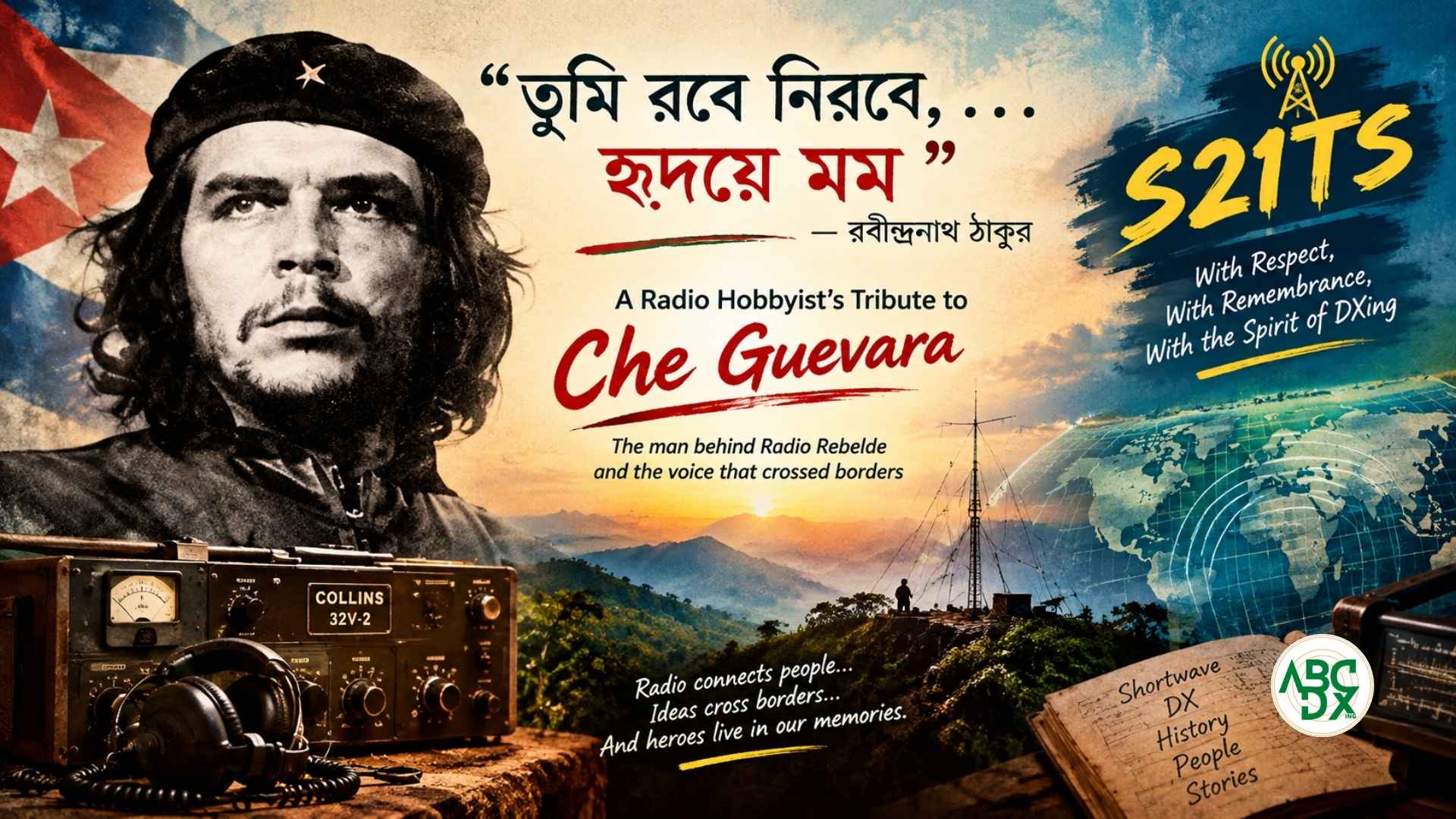

Che Guevara A Man Through the Shortwave Radio
Every October 9 brings back memories of a man who occupied a special place in my childhood imagination. Ernesto Che Guevara remains a figure whose legacy inspires admiration in some people and strong criticism in others. History, after all, is rarely viewed from a single window. Here we would like to discover the power of Shortwave he used in his life.
Today, however, I do not wish to revisit his political ideology, military campaigns, or the controversies surrounding his life. I want to remember him from a different perspective: that of a radio enthusiast who has spent years exploring the fascinating world of shortwave broadcasting.
Radio has often served purposes far beyond entertainment. It has connected isolated communities, carried news across borders, challenged information monopolies, and allowed voices to travel where ordinary communication could not reach.
During the Cuban Revolution, radio became an important instrument of communication. At the centre of this story stands Radio Rebelde, a clandestine broadcaster established under Guevara's direction in the Sierra Maestra mountains in February 1958.
For a shortwave enthusiast, its early history is particularly compelling. A modest transmitter, an improvised broadcasting site, and a small team of dedicated people helped establish a station that would become an important part of Cuban broadcasting history.
This is the story I want to explore today. Not the familiar portrait on a poster, but the man associated with a transmitter, an antenna, and the extraordinary ability of radio waves to cross difficult terrain.
1. Voice of Che Guevara Without Borders
Before examining Shortwave Radio Rebelde, we need to look briefly at Guatemala in 1954. Che Guevara was in Guatemala during the political crisis that culminated in the overthrow of President Jacobo Árbenz. The period demonstrated how radio could become an instrument of psychological warfare and political communication.
A clandestine broadcaster known as La Voz de la Liberación associated with the campaign against Árbenz's government. Operating outside the ordinary national broadcasting structure, it transmitted messages intended to undermine confidence in the government and strengthen the opposition.
The wider historical record documents the station's existence and the importance of clandestine radio during the crisis. However, claims about precisely what Guevara heard, how regularly he listened, and how directly those broadcasts shaped his later decisions require careful sourcing.
For radio historians, the essential lesson is clear: a transmitter did not need to control a country's broadcasting infrastructure to influence the information reaching its population.
A clandestine station could operate from outside the normal broadcasting system, exploit the reach of radio waves, and deliver a message into a politically sensitive environment.
It was a powerful demonstration of radio's potential. It was also a reminder that the same technology could serve competing political interests.
2. February 1958: The Birth of Radio Rebelde
The most important chapter in the radio story of Che Guevara began in Cuba's Sierra Maestra mountains. On February 24, 1958, Radio Rebelde began broadcasting from the rebel encampment at Altos de Conrado. The shortwave station established under Guevara's direction, with Captain Luis Orlando Rodríguez serving as its first director. Technical work involved Eduardo Fernández and other members of the team.
The circumstances were far removed from a modern broadcasting studio.
The equipment had to be transported into mountainous territory, installed at a suitable location, and operated under conditions in which discovery could threaten the entire operation. The station's purpose was to carry information from the rebel movement to listeners beyond its immediate surroundings.
According to the station's own historical account, the first transmission lasted approximately twenty minutes. It included the rebel anthem, reports about military events, and an editorial explaining the purpose of the new broadcaster.
The station's opening identification would become familiar in Cuban broadcasting history:
“¡Aquí Radio Rebelde!”
Here is Radio Rebelde!
For listeners accustomed to the formal announcements of established international broadcasters, there is something striking about this beginning. Radio Rebelde did not emerge from a national broadcasting corporation with elaborate studios and extensive engineering facilities. It began as a small operation working under difficult conditions.
Yet the team understood an important principle of broadcasting: a transmitter is useful only when it can deliver information to an audience.
3. The Transmitter: A Story for Radio Enthusiasts
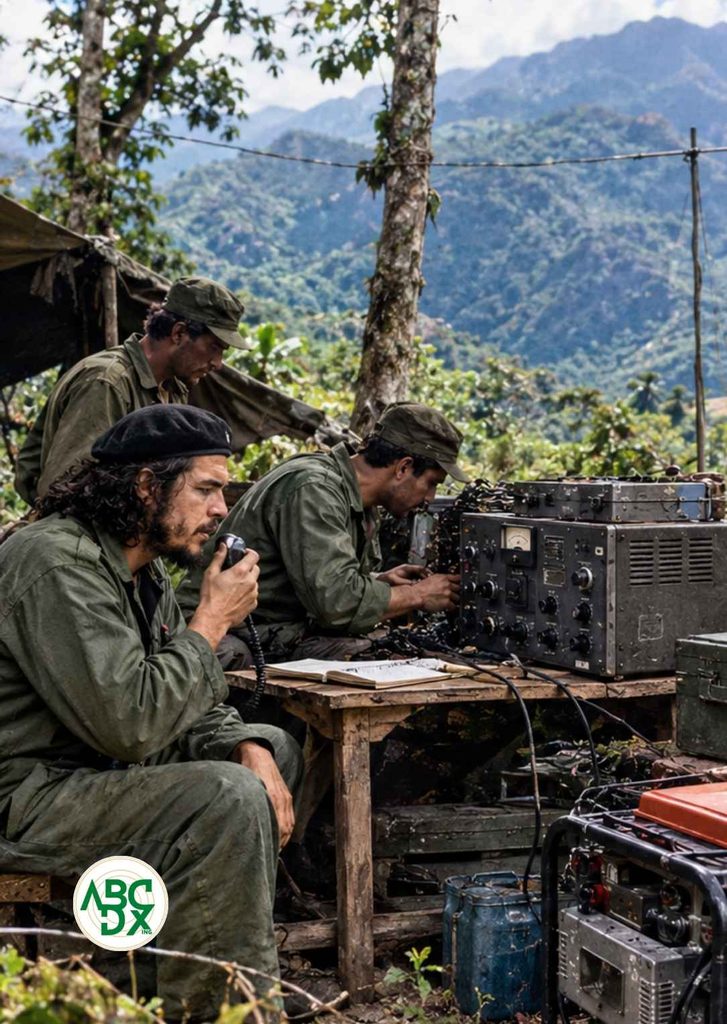
One of the most interesting details in Radio Rebelde's early history is its equipment.
Historical accounts identify the original transmitter as a Collins 32V-2, a model associated with the amateur-radio equipment of its period. It was accompanied by an electrical generator and the other equipment needed to establish a functioning station.
The Collins 32V-2 designed to operate across several shortwave amateur bands. That made it a technically interesting choice for a clandestine broadcasting operation, although the transmitter's original design was not specifically intended for revolutionary broadcasting.
For a DXer, this is where the story becomes especially vivid.
Imagine trying to establish a shortwave station in a mountainous region without the advantages of a permanent broadcasting centre. Equipment had to be carried into the area. A power supply had to be arranged. An antenna needed to erected in a useful location while remaining as inconspicuous as possible.
The technical team had to contend with practical questions familiar to radio operators everywhere. Was the transmitter functioning correctly? Could the antenna provide useful coverage? Was the power supply dependable? Could the equipment survive the surrounding conditions?
These were not abstract engineering questions. They determined whether the station could be heard.
The Collins 32V-2 could operate on the 20-metre amateur band, which was central to Radio Rebelde's initial transmissions. Accounts of its early broadcasts identify 5 p.m. and 9 p.m. as the original daily transmission times.
The station later expanded its operations and used additional shortwave facilities, including the 40-metre band.
Exact transmitter output figures differ across secondary accounts, so it is sensible to verify the original equipment specifications before publishing a precise power rating. The important point is that this was modest equipment being used creatively in an unusual broadcasting environment.
For a shortwave listener today, the Collins name may evoke classic radio engineering. In this story, it also represents the practical relationship between equipment, ingenuity, and the ability to communicate over distance.
4. Che and Shortwave From the Mountains
Radio Rebelde's early use of the 20-metre band is worth examining from a technical perspective.
Shortwave propagation differs from ordinary local AM or FM reception. Under suitable ionospheric conditions, signals in the high-frequency spectrum can travel far beyond the transmitter's immediate surroundings.
The 20-metre amateur band occupies approximately 14 MHz. It is commonly associated with long-distance communication, although the precise distances and reliability depend on frequency, time of day, solar conditions, antenna characteristics, and the ionosphere.
For a station broadcasting from the Sierra Maestra, this offered an opportunity to reach listeners well beyond the immediate camp.
However, shortwave has a complication that experienced DXers understand. A signal may travel a great distance while being difficult to receive nearby. Depending on the propagation conditions, there can be a skip zone between the areas of strong groundwave reception and the distant region where the signal returns to Earth.
This helps explain why different frequencies and transmission arrangements could be useful for different coverage requirements.
Historical accounts describe Radio Rebelde's expansion to include the 40-metre band, which could help serve a different reception area under suitable propagation conditions. The actual coverage would still have depended on the operating frequency, antenna, transmitter performance, terrain, and time of transmission.
We should not imagine that one frequency automatically covered every part of Cuba. Radio propagation is more complicated than that.
Nevertheless, the use of shortwave gave Radio Rebelde a means of communicating beyond the physical limitations of its mountainous location.
For radio hobbyists, this remains one of the most fascinating aspects of the story: a relatively small station using the behaviour of the ionosphere to overcome geographical barriers.
5. What Did Radio Rebelde Broadcast?
Radio Rebelde was not simply a transmitter carrying occasional political speeches.
Its early programmes included news about military developments, reports from the rebel movement, editorials, and other material intended to communicate with the Cuban public.
The station also became a means of announcing significant events. Its broadcasts included reports from the fighting and information that was difficult to obtain through other channels during the conflict.
One reason the station mattered was that access to independent information was restricted by the wider political and military circumstances. Radio offered a way to communicate directly with listeners rather than depending entirely on the established press.
That does not mean every broadcast should be treated as an impartial news report. Radio Rebelde represented a particular movement and communicated its perspective. Its historical significance lies partly in the fact that it created an alternative channel of information during a period of conflict.
From a broadcasting perspective, the important questions are familiar:
Who controlled the transmitter? Who selected the material? Which audiences could receive the signal? How did listeners evaluate what they heard?
These questions remain relevant when studying clandestine broadcasters from any period.
6. From One Transmitter to a Wider Network
Radio Rebelde did not remain a single isolated station.
As the conflict progressed, its operations expanded. The broadcasting organisation developed links with the wider rebel movement, while additional transmitters and radio equipment supported communications among different groups.
Historical accounts describe the growth of a network of Radio Rebelde stations. The equipment served both a broadcasting purpose and a wider communications role.
This distinction is important. A shortwave broadcast intended for the public and a radio link used to communicate between field units are not the same thing, even when both rely on radio technology.
The development of Radio Rebelde illustrates how a small clandestine broadcaster could evolve into a larger communications operation.
It also demonstrates that radio history is rarely just the story of a transmitter. Behind every station are technicians, announcers, writers, operators, power supplies, antennas, transport arrangements, and people responsible for keeping the service functioning.
For the radio historian, these less visible contributions deserve attention alongside the names of prominent leaders.
7. Radio Havana Cuba: The International Broadcasting Connection
Rebelde's Radio history is closely associated with the emergence of Cuba's later international broadcasting service, Radio Havana Cuba.
Radio Havana Cuba officially began international shortwave broadcasting in May 1961. Its purpose was to communicate Cuba's official perspective to audiences outside the country.
The idea of an international service had developed during the final stage of the Cuban Revolution. Radio Rebelde had demonstrated the potential of broadcasting, while the subsequent international service offered a way to reach listeners abroad.
But an important distinction must be made.
Radio Havana Cuba was not founded by Guevara in the same direct sense as Radio Rebelde. Its establishment belongs to the later development of Cuban state broadcasting. Guevara's connection is historical and contextual, rather than evidence of his personal operation of the international service.
For international DXers, Radio Havana Cuba became a familiar name on the shortwave bands. Its broadcasts carried news, commentary, music, cultural programmes, and the Cuban government's perspective on international affairs.
The station also became part of the wider history of Cold War broadcasting, when international radio services competed to reach audiences across political and geographical boundaries.
For listeners in distant countries, shortwave provided a way to hear voices from places they might never visit. Reception could be unpredictable, but the experience of discovering an overseas station remained one of the great attractions of the hobby.
8. Bolivia, 1966–1967: When Communications Became a Weak Point
The Bolivian campaign offers a contrasting chapter in this radio history.
By this stage, Guevara was operating far from the broadcasting environment associated with Radio Rebelde. His guerrilla group faced serious difficulties with logistics, local support, security, and communication.
A declassified United States government document concerning the Bolivian campaign records that the guerrillas received radio communications from Cuba but were unable to transmit back because their radio equipment had become damp and rusty while stored in a cave. The document also describes local communication between sections of the group using low-power transceivers.
This account reveals an important difference between receiving and transmitting.
A receiver may continue to provide useful information even when an organisation cannot send a reply. A two-way communication system, however, depends on functioning equipment at both ends of the link.
Moisture, corrosion, damaged components, inadequate power, and poor storage can all undermine radio reliability. In difficult field conditions, even equipment that works perfectly in a laboratory can become unreliable.
The Bolivian evidence therefore provides a useful counterpoint to the earlier success of Radio Rebelde.
In Cuba, radio had helped a movement communicate with a wider audience. In Bolivia, radio communications were among the practical difficulties faced by a small guerrilla force operating under increasingly adverse conditions.
It would be inaccurate to describe Guevara's Bolivian operation as another successful shortwave broadcasting station. The available evidence instead points to communication links that struggled to function reliably.
For radio enthusiasts, this is an important lesson in the difference between a public broadcasting service and field communications.
9. The Stations We Should Not Confuse With Guevara's Own Work
A radio tribute becomes stronger when it acknowledges the limits of the evidence.
Several broadcasters belong to the wider history of revolutionary and international radio, but their existence does not establish Guevara's personal involvement.
La Voz de la Liberación belongs in the background to his Guatemala experience, with careful attention to what can be documented about his exposure to it.
Radio Rebelde belongs at the centre of the story because of its direct connection to his role in establishing the station in Cuba.
Radio Havana Cuba belongs in the later history of Cuban international broadcasting. It was part of the broadcasting environment that followed the revolution, rather than a station Guevara personally founded.
Other clandestine broadcasters, foreign services, and rebel radio networks may provide useful comparisons. However, they should only be included as direct personal connections when documentary evidence supports that claim.
This distinction is especially important for DXers. We are accustomed to identifying stations by callsigns, frequencies, schedules, transmitters, and programme details. Historical radio research deserves the same discipline.
A station's political association is not proof of a person's operational involvement.
10. Why Che Still Matters to Shortwave Listeners
The history of Radio Rebelde offers several lessons that extend beyond its original political setting.
First, radio can provide communication when conventional media channels are restricted or unavailable.
Second, technical ingenuity matters. Equipment, antennas, power supplies, propagation, and the skills of the operators all contribute to whether a station succeeds.
Third, radio signals do not respect national borders in the same way as printed newspapers or physical infrastructure. Shortwave can carry a voice across mountains, coastlines, and international boundaries, subject to propagation conditions.
Finally, the history reminds us that a broadcaster's reach and a broadcaster's credibility are separate questions. A powerful or widely heard station may influence audiences, but listeners still need to assess the information it provides.
These are not lessons confined to revolutionary radio. They are part of the broader history of international broadcasting.
For those of us who enjoy tuning across the shortwave bands, that history gives familiar frequencies a deeper meaning. Behind a signal may be a remarkable story of engineering, human effort, risk, and the desire to communicate.
Conclusion: Beyond the Portrait, There Was a Radio Station
On this October 9 anniversary, I remember Che Guevara through one particular chapter of his life: his association with the creation of Radio Rebelde.
I do not need to revisit every political argument surrounding his name to appreciate the historical significance of that station. Nor should an interest in its technical achievements require us to overlook the controversies surrounding the wider events of the period.
My interest is narrower and, for me, deeply personal. It is the interest of a radio hobbyist who knows that a transmitter is more than a collection of electronic components. It is a means of carrying a human voice beyond the horizon.
In the Sierra Maestra, Radio Rebelde began with modest equipment and a small team. Its broadcasts became part of Cuba's communications history. Later, the wider development of Cuban international broadcasting carried the country's voice to shortwave listeners around the world.
The Bolivian experience, meanwhile, reminds us that radio can also fail when equipment and field conditions become hostile.
These contrasting chapters make the story worth remembering. They show both the possibilities and the limitations of radio in the real world.
For me, this is the most meaningful way to approach the anniversary: not through another political portrait, but through the history of the waves that carried messages across a divided landscape.
As a lifelong radio enthusiast, I remain fascinated by those waves, by the people who put them on the air, and by the listeners who searched the bands to hear them. And that is why, on this October 9, I remember the man behind Radio Rebelde through the enduring history of shortwave radio.
My primary and specialist sources for this article:
Radio Rebelde, Cuba, 1958
Founding date: February 24, 1958, according to the station's own historical account. Guevara's clearest and best-documented radio legacy. We can investigate the station's origins, equipment, early shortwave bands, program content, and expansion into a communications network. Che had direct communication with this radio.
Radio Rebelde's official history: The station's own account of its founding, original broadcasts, and early staff. Visit Radio Rebelde
La Voz de la Liberación, Guatemala, 1954
The clandestine station associated with the campaign against President Jacobo Árbenz provides important context for understanding Guevara's exposure to political radio. Reliable biographical evidence should establish the extent of his direct listening experience, rather than assuming it. This influenced us to investigate further for this blog.
National Security Archive: A declassified intelligence document concerning Guevara's Bolivian campaign and radio communications. Read the declassified document
Radio Havana Cuba, from 1961
This international shortwave broadcaster carried Cuba's official voice to overseas audiences. Its origins can be traced to the earlier revolutionary broadcasting project, but it should not be presented as a station personally founded by Guevara. We bound to follow this for Related legacy of Guevara. Visit Radio Havana Cuba
Collins Radio Association: Technical historical material on the 32V-2 transmitter, useful for checking its original specifications. Read the transmitter history
World Radio History: A specialist archive with a Monitoring Times article on the Sierra Maestra and Radio Rebelde, written from a radio-monitoring perspective. Read the historical radio article