
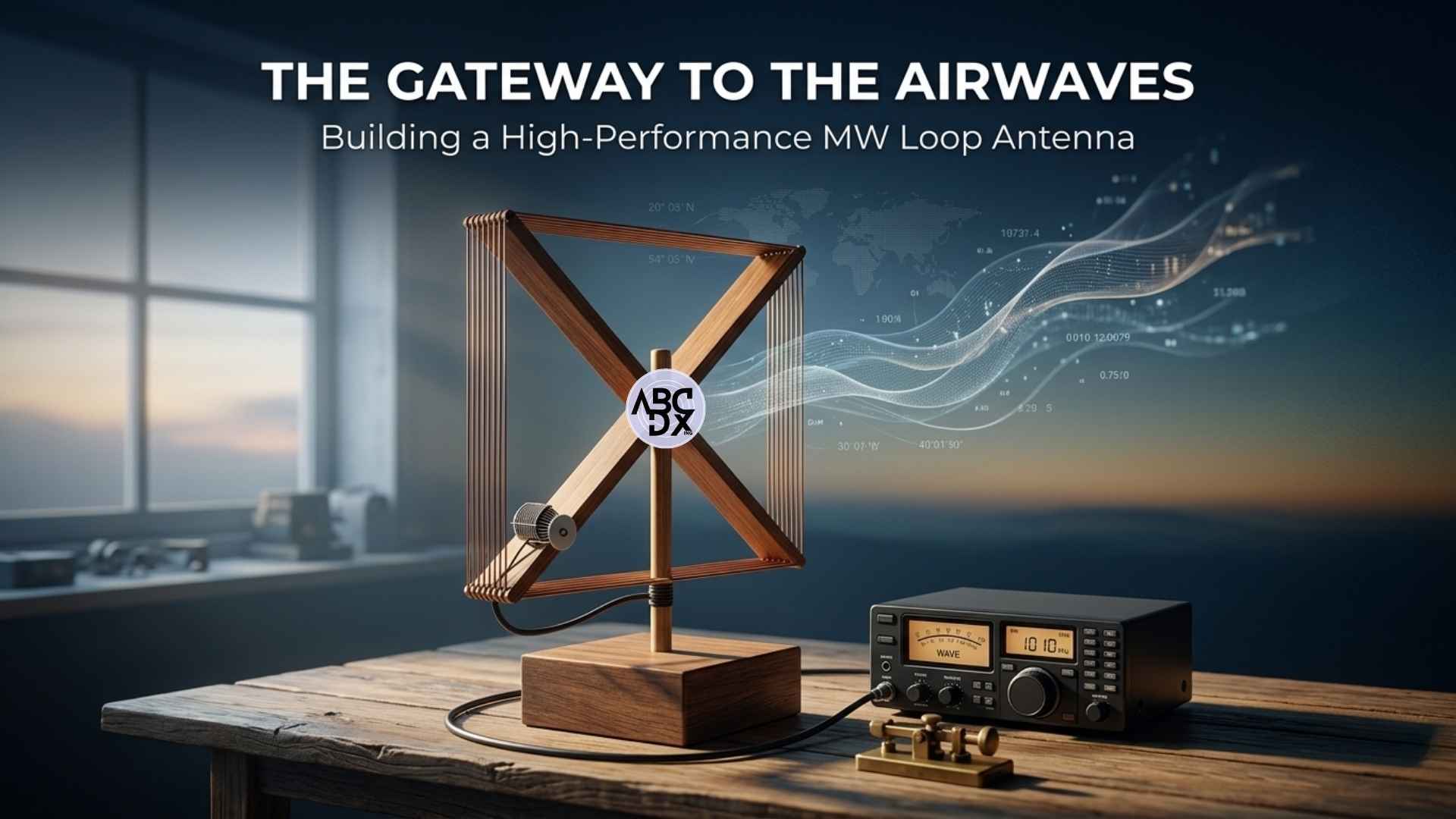

The art of MW DXing means the hobby of receiving distant radio signals. This Medium Wave often feels like a forgotten magic in our hyper-connected digital age. While we live in a world of high-speed fiber and satellite links, there is a profound satisfaction in pulling a signal from thousands of miles away using nothing but physics and a well-constructed antenna.
One of the most effective tools for this pursuit is the Passive Large-Frame Loop Antenna. Below is a professional guide on how to construct and install this classic DXing powerhouse.
The Gateway to the Airwaves: Building a MW Loop Antenna for DXing
In the world of radio, "DX" stands for distance. For a Medium Wave enthusiast, the challenge isn't just sensitivity; it’s selectivity and noise rejection. Modern homes are filled with Electromagnetic Interference (EMI) from LED lights, computers, and chargers. A large-frame loop antenna is the ultimate solution because it responds to the magnetic component of the radio wave, naturally nulling out much of the electrical noise that plagues standard wire antennas.
Technical Specifications
Based on the classic 1-meter frame design, here are the parameters for a high-efficiency build:
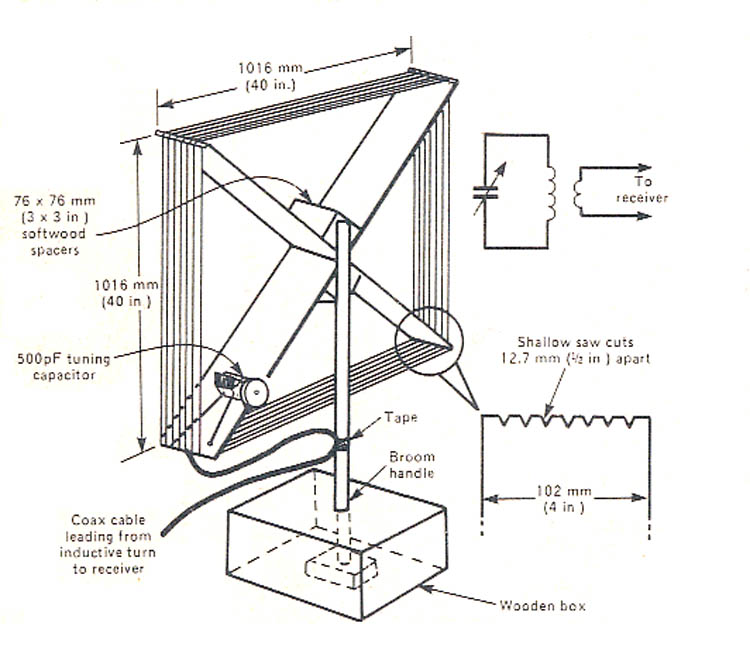
Frame Dimensions: 1016 mm x 1016 mm (approx. 40 x 40 inches).
Winding Material: Insulated copper wire (Litz wire is preferred for high "Q", but standard 18–22 AWG hookup wire works excellently).
Winding Spacing: 12.7 mm (1/2 inch) between turns, maintained by shallow saw cuts in the frame spacers.
Tuning Capacitor: 500pF variable air-gap capacitor.
Coupling: Inductive (a single-turn secondary loop leads to the receiver via coax).
Step-by-Step Construction & Installation
1. The Framework
Construct an "X" frame using sturdy, non-conductive materials. A common and effective choice is a repurposed broom handle for the vertical support and softwood cross-members.
- Install 76 x 76 mm (3x3 inch) spacers at the four tips of the "X".
- Cut shallow notches into these spacers exactly 12.7 mm apart. This spacing is critical to reduce "inter-turn capacitance," which allows the antenna to tune more sharply.
2. Winding the Main Loop
Starting at the bottom, wind the wire around the frame through the notches. For the standard AM broadcast band (530–1700 kHz), approximately 8 to 10 turns are generally required when using a 500pF capacitor. Connect the two ends of this large coil directly to the terminals of your 500pF variable capacitor.
3. The Inductive Pickup
Unlike a standard antenna, the main loop is not physically connected to your radio. Instead, you wind a single turn of wire parallel to the main loop (usually on the inside or just beside it). This "pickup loop" connects to a coaxial cable (like RG-58) which then runs to your receiver’s antenna input.
4. Positioning and Mounting
For maximum stability, mount the assembly on a heavy wooden box or a tripod. The antenna must be able to rotate 360 degrees.

Operating the Antenna: The DXer’s Technique
Installation is only half the battle; operation is where the expertise comes in.
- Directivity: The loop is highly directional. The "lobes" (maximum signal) are in line with the plane of the loop, while the "nulls" (minimum signal) are perpendicular to the loop. If a local station is drowning out a distant signal, rotate the loop so the "edge" points toward the station you want to hear and the "flat face" points toward the interference to cancel it out.
- Resonant Tuning: As you change frequencies on your radio, you must slowly turn the 500pF capacitor on the antenna. You will feel the signal "peak" suddenly. This creates a high-Q circuit that acts as a physical pre-selector, narrowing the bandwidth and boosting weak signals.
Why MW DXing Matters Today
In an era of "Open Source" information, the radio spectrum remains one of the few truly decentralized ways to access the world. DXing is the original open-source intelligence. You aren't relying on an ISP or a platform algorithm; you are interacting directly with the ionosphere.
Whether you are hunting for low-power community stations or "clear channel" giants from across the continent, building your own antenna is the first step toward mastering the airwaves. It is a bridge between the craftsmanship of the past and the technical curiosity of the future.
Happy Hunting and 73s!