
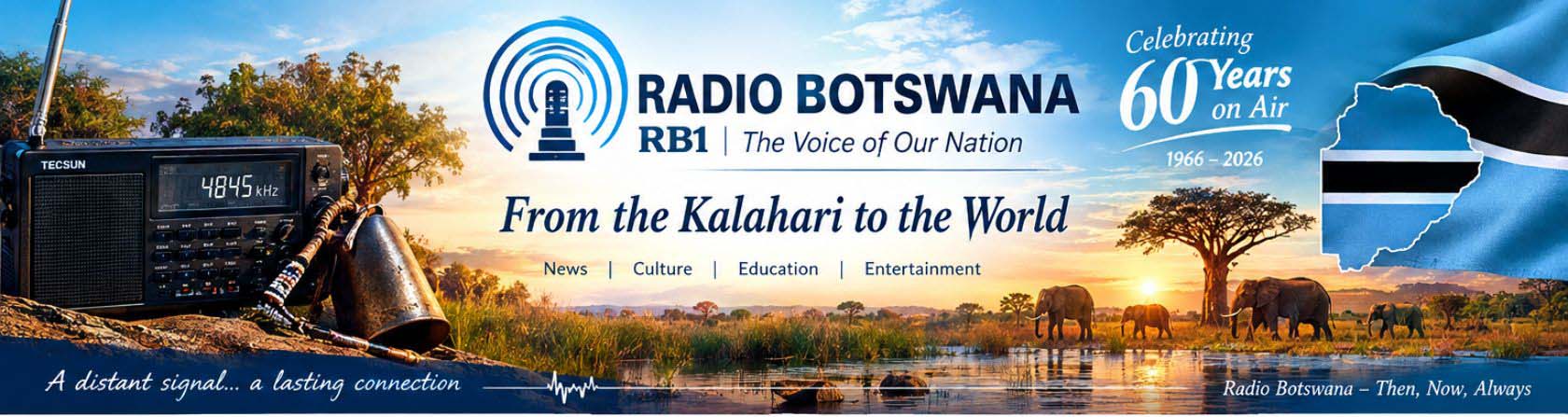

Radio Botswana: The Voice of a Young Nation and a Classic African DX Catch
There are some radio stations that are remembered because of their powerful transmitters. Others are remembered because of their international reach. And then there are stations remembered for something much more personal: the feeling of discovering a distant country through a few thousand kilometres of radio propagation. Radio Botswana belongs firmly in the third category.
For generations of shortwave listeners, the name Botswana was associated with a distinctive African soundscape. A faint signal emerging from the noise, a few words in Setswana, an English announcement, music from southern Africa and, most famously, the sound of cowbells forming the station's memorable interval signal. For a DXer sitting beside a shortwave receiver thousands of kilometres away, those sounds were more than programming. They were proof that the radio spectrum could collapse geographical distance. Radio Botswana began its modern broadcasting life in the mid-1960s as Radio Bechuanaland, shortly before the territory achieved independence. It became Radio Botswana after independence in 1966 and developed into the country's principal national radio service.
Today, the station is known as RB1, carrying news, current affairs, culture, education, entertainment and national programming. In 2026, Radio Botswana is itself celebrating 60 years on air, making this an especially appropriate moment to revisit its remarkable history.
Botswana: The Land Behind the Radio Signal
Before tuning across the African shortwave bands, it helps to understand the country that produced the signal.

Botswana is a landlocked country in southern Africa, bordered by South Africa to the south and southeast, Namibia to the west and north, Zimbabwe to the northeast, and a short international boundary with Zambia in the north. Much of the country lies within the vast Kalahari region. The landscape is dominated by dry savanna, grasslands and semi-arid terrain, although the northern part of the country includes the extraordinary Okavango Delta. The country's area is approximately 581,730 square kilometres. Its capital and largest city is Gaborone, located in the southeast near the South African border.
Botswana uses Central Africa Time, UTC+2, throughout the year. According to the country's 2022 Population and Housing Census, Botswana had 2,359,609 inhabitants. Christianity is the dominant religious affiliation. The 2022 census found that 86.5% of people who stated a religious affiliation identified as Christian, while African Traditional Religions accounted for 4.6%, and 7.1% reported no religious affiliation.
The cultural identity of Botswana is closely connected with its Setswana heritage. Setswana is the principal national language, while English has an important official and administrative role. Traditional life has long been centred around communities, cattle, agriculture, music, dance and the kgotla, the traditional community gathering and consultation system. Traditional clothing varies by community and occasion, but blankets, patterned fabrics, beadwork and ceremonial dress remain important cultural expressions. Cattle have also held enormous social and economic importance in Botswana. That connection with cattle makes Radio Botswana's famous cowbell interval signal particularly appropriate. It was not simply a clever radio signature. It reflected the cultural landscape from which the station was broadcasting.
Broadcasting Before Independence
The story of Botswana's radio broadcasting actually reaches further back than the birth of Radio Botswana.
During the colonial period, the territory was known as the Bechuanaland Protectorate. Radio facilities were initially connected with government administration, veterinary services and communication rather than with the modern concept of a national broadcasting network.
Historical research shows that radio exposure existed in Botswana during the 1940s, while the development of organized broadcasting accelerated in the early 1960s. A 1 kW medium-wave transmitter that had originally been associated with wartime communications was moved from Mafikeng to Lobatse in 1963. It became part of the emerging information network serving the territory.
The early broadcasting story is therefore closely connected with the practical needs of the colonial administration.
Radio was used to distribute information over a territory where population centres were widely scattered. Agricultural information was particularly important. Veterinary communication also played a role because livestock were central to the economy and rural life. Academic research into Botswana's early broadcasting history shows that the development of radio was influenced by the competing political interests of British colonial authorities, South African authorities and local African institutions. Radio was therefore not merely a technological development. It was part of the wider political history of southern Africa.
Radio Bechuanaland: The Beginning of the Botswnan National Voice
The decisive stage came in 1965.
Radio Bechuanaland began operating from Lobatse and later moved its main operations towards the new capital, Gaborone. The station developed rapidly during the period immediately preceding independence.
Historical broadcasting records indicate that a 10 kW shortwave transmitter was installed at the Sebele site near Gaborone during this period. This was an important development because shortwave allowed the station to reach far beyond the immediate coverage area of a local medium-wave transmitter.
Then came the moment that changed everything.
On 30 September 1966, Bechuanaland became the independent Republic of Botswana. Radio Bechuanaland adopted the country's new name and became Radio Botswana. The station was suddenly more than a colonial information service. It had become the broadcasting voice of an independent African nation.
For a newly independent country, this was enormously significant.
The national broadcaster could communicate government information, national development programmes, education, culture, music and news to communities spread across a large and sparsely populated territory.
Radio was not simply entertainment. Radio was nation-building.
From Government Communication to a National Broadcaster
In its early years, Radio Botswana had an enormous responsibility.
The country had gained independence with a small population and limited infrastructure. Many communities were rural and widely separated. Newspapers could not reach everyone quickly. Television had not yet become a major medium.
Radio could.
The station's programming combined Setswana and English, reflecting the country's linguistic and administrative realities. News, educational material, agricultural information, cultural programmes, music, religious broadcasts and government information formed important parts of the schedule.
A historical programme schedule from the 1960s gives us a wonderful glimpse into the character of the station. It included BBC news, English and Tswana news, women's programs, music, church services, weather forecasts, educational programs, sports information and cultural material.
For today's listener, such a schedule might look simple.
For the people of newly independent Botswana, it was revolutionary.
The Shortwave Era of Radio Botswana
Now we arrive at the part of the story that will be particularly familiar to DXers.
Shortwave Radio Botswana was a genuine African DX classic.
The station operated several shortwave frequencies over the years. Among the best-known were 3356 kHz and 4845 kHz, while other frequencies appeared in different periods and schedules.
By the 1980s and early 1990s, Radio Botswana had become a regular entry in international shortwave publications and DX bulletins.
One of the most famous frequencies was 4845 kHz.
For many DXers, 4845 kHz became almost synonymous with Botswana.
An archived recording from 2 January 1981 documents Radio Botswana transmitting from Sebele on 4845 kHz with 10 kW at 0357 GMT. The recording preserves the distinctive cowbell and cattle sounds used as the station's interval signal. The reception was made in Lexington, Kentucky, demonstrating just how far the signal could travel under favourable propagation conditions.
Another surviving 1983 recording, received in Ontario, Canada, contains the station's interval signal, national anthem and sign-on announcements.
Just imagine the experience.
A DXer in North America turns the dial around the 60-metre band in the early morning.
The band is noisy.
Signals rise and fall.
Then suddenly: Cowbells.
A few seconds later, a voice from southern Africa. That was the magic of Radio Botswana.
The Famous Cowbell Interval Signal
For serious shortwave listeners, an interval signal can become almost as recognizable as a station's call sign.
Radio Botswana had one of the most memorable in Africa.
Instead of relying entirely on a musical tune, the station used the sound of cowbells and cattle.
It was wonderfully appropriate.
Botswana's traditional economy and cultural identity have long been strongly associated with cattle. The sound therefore carried a sense of place before the announcer even spoke.
For a DXer, this was extremely useful.
When a weak signal appeared in the noise, hearing those bells could immediately suggest:
Botswana. This is one reason historical Radio Botswana's recordings are so valuable today. They preserve not only the station's programming but also an acoustic fingerprint of an earlier broadcasting era.
Radio Botswana and the Southern African DX Scene
Radio Botswana occupied an interesting position on the shortwave dial.
It was not an international broadcaster in the same sense as the BBC World Service, Radio Nederland, Radio Canada International or Deutsche Welle.
Its primary purpose was domestic broadcasting.
But shortwave does not respect political borders.
Under favourable propagation conditions, the Botswana signal could travel hundreds or thousands of kilometres beyond its intended audience.
That made Radio Botswana particularly attractive to DXers.
Southern Africa was one of the most rewarding regions for serious shortwave listeners. Stations from Zimbabwe, Zambia, Malawi, South Africa, Lesotho, Swaziland and Botswana could sometimes appear on the bands, especially during favourable propagation periods.
The challenge was identifying them correctly. This was where interval signals, language, programme content, frequencies and reception characteristics became important.
A Look at the Historical Frequencies
The historical record shows that Radio Botswana's frequency assignments changed over the decades.
A 1995 Monitoring Times listing, for example, documented Radio Botswana on:
| Frequency | Band | Historical use |
| 3356 kHz | 90 metres | Domestic shortwave |
| 4830 kHz | 60 metres | Domestic shortwave |
| 5965 kHz | 49 metres | Daytime service |
| 7255 kHz | 41 metres | Daytime service |
| 9600 kHz | 31 metres | Daytime service |
The same historical source also recorded medium-wave services and relays.
Older monitoring material also records Radio Botswana on 9595 kHz, showing how frequencies could change according to schedule and transmission requirements.
This is an important lesson for today's DXers.
A historical frequency should never automatically be treated as a current frequency.
Shortwave schedules change. Transmitters are retired. Domestic broadcasters migrate from AM and shortwave to FM. Some frequencies disappear completely. That is precisely what happened to Radio Botswana.
From Shortwave to FM
Like many domestic broadcasters around the world, Radio Botswana gradually moved away from its traditional shortwave identity.
FM offered several advantages.
It provided much better audio quality for music and speech within coverage areas. It also fitted the changing broadcasting environment, where listeners increasingly expected clear local reception.
Botswana's regulator, the Botswana Communications Regulatory Authority, notes that FM has become the preferred transmission technology in the country's broadcasting sector, although Radio Botswana has historically retained some AM broadcasting capability.
Today, the best-known RB1 frequency in Gaborone is 89.9 MHz FM. RB1 remains a national public broadcasting service, carrying news, current affairs, culture, education and entertainment.
This represents a dramatic technological journey.
3356 kHz → 4845 kHz → AM/FM networks → online listening
The medium changed. The mission survived.
Radio Botswana II and the Expansion of Domestic Radio
Radio Botswana's history did not stop with RB1.
On 6 April 1992, Radio Botswana II, commonly known as RB2, went on air. It initially operated with a 100-watt transmitter and coverage of roughly 50 kilometres around Gaborone. The station later developed into a nationwide network.
RB2 brought another dimension to Botswana's radio environment.
It was designed with a different programming character and eventually became an important part of the country's broadcasting landscape.
The arrival of RB2 also marked the beginning of a more diversified radio environment.
For decades, Radio Botswana had been the country's dominant broadcaster. Commercial and private radio services later emerged, ending the earlier monopoly. The 1999 Broadcasting Act created a formal regulatory framework for broadcasting licences and the National Broadcasting Board.
Radio as a Cultural Archive
One of the most important functions of Radio Botswana is sometimes overlooked.
A national radio station does not merely report the present.
It preserves the past.
Through music, oral traditions, interviews, folklore, local news, traditional poetry and community voices, radio creates an enormous cultural archive.
This is especially important in a country with multiple languages and distinct cultural communities.
Recent changes demonstrate that this role remains relevant. In 2025, Radio Botswana and Botswana Television began introducing news bulletins in indigenous languages including iKalanga, Shekgalagari, Shiyeyi and Naro, with further languages planned as part of the country's 60th independence anniversary preparations.
From a broadcasting perspective, this is fascinating.
The technology has changed dramatically.
But the fundamental idea remains the same:Use radio to make the nation hear itself.
Radio Botswana at 60
There could hardly be a better time to revisit this station.
In 2026, Radio Botswana is marking 60 years on air.
The station has been taking its anniversary celebrations into communities across the country. A particularly touching example came in August 2026, when RB1 conducted a live broadcast from Matsiloje as part of its 60th anniversary activities.
The broadcast also remembered veteran broadcaster Phillip "Mokgankgara" Moshotle, whose distinctive voice became deeply associated with Radio Botswana. Local listeners remembered him as someone who made radio feel like part of the family.
That description says something important about national radio.
Technical specifications tell us about transmitters.
Frequency tables tell us about propagation. But listeners remember voices.
The DXer's View: Why Radio Botswana Matters
For an experienced DXer, Radio Botswana represents several important chapters in shortwave history.
1. It was a genuine African domestic DX target
The station was never primarily designed for international listeners. Yet propagation allowed its signals to escape far beyond Botswana.
2. It had excellent identification characteristics
The cowbell interval signal was especially valuable when reception was weak.
3. Its frequencies were relatively distinctive
Signals around 3356 and 4845 kHz became familiar landmarks for African-band DXers.
4. It represented a geographically difficult target
Botswana is thousands of kilometres from many listening locations in Europe, Asia and North America.
5. It carried genuine local programming
Unlike an international broadcaster targeting foreigners, Radio Botswana gave DXers a window into Botswana itself.
That last point is perhaps the most important.
Listening to Radio Botswana was not simply listening to another shortwave station. It was listening to Botswana.
Why the Station Became a Shortwave Legend
The golden age of African shortwave DXing was built around stations that were never intended to become international celebrities.
That is precisely what made them special.
Radio Botswana did not need a huge international transmitter network. It did not need a multilingual world service.
A modest transmitter, a good antenna, the right propagation conditions and a patient listener were enough.
The reward could be extraordinary.
A listener in Europe might hear Setswana.
In North America might hear the cowbells.
Or in Asia might catch a faint African signal during the right seasonal propagation conditions. And suddenly the map became real.
Radio Botswana and the QSL Tradition
For generations of DXers, hearing a difficult African station was only half the adventure.
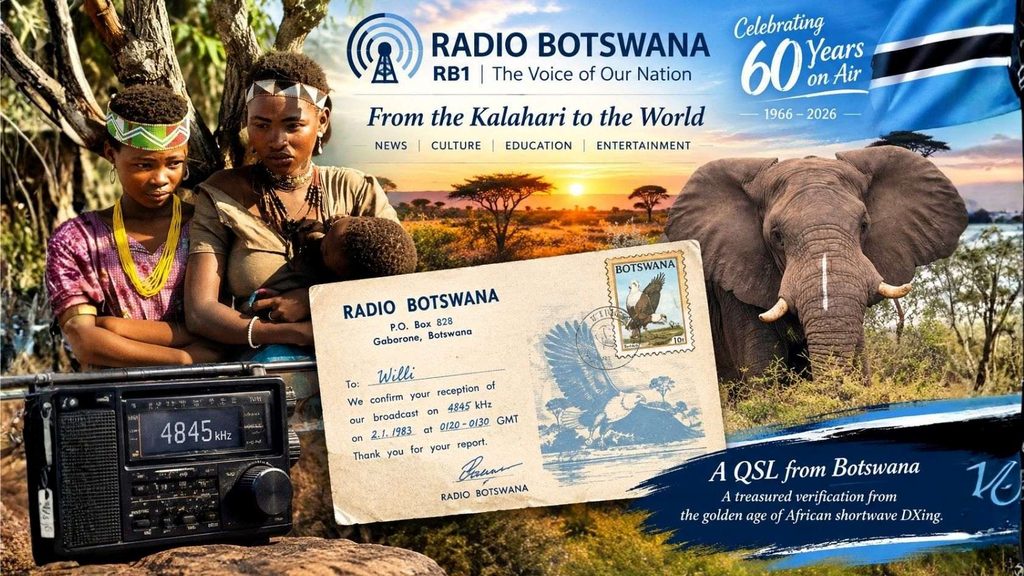
The next challenge was obtaining a QSL, a verification of reception.
Radio Botswana became one of those stations that could inspire serious QSL hunting.
The attraction was understandable.
A QSL card from Gaborone represented more than confirmation of a frequency. It was physical evidence that the listener's antenna had captured a signal from one of Africa's most geographically isolated broadcasting environments.
For today's collectors, old Radio Botswana QSL cards, program schedules, pennants, station photographs and recordings are increasingly valuable pieces of radio history.
The surviving recordings are particularly precious because many of the original transmissions have disappeared from the air.
The End of an Era
There is a bittersweet side to the Radio Botswana story.
For today's listener, tuning to 4845 kHz and expecting Radio Botswana is unlikely to produce the experience that DXers enjoyed decades ago.
The shortwave chapter has effectively become historical.
But this should not be interpreted as the death of Radio Botswana.
Quite the opposite.
The station survived the transition from colonial administration to independence.
It survived the expansion of television.
RB survived the arrival of commercial radio.
It survived the migration from shortwave and AM toward FM.
And it has now entered the digital age.
The transmitter changed, audience changed, technology changed.
But the voice remained.
Radio Botswana: From 10 kW to the Digital Age
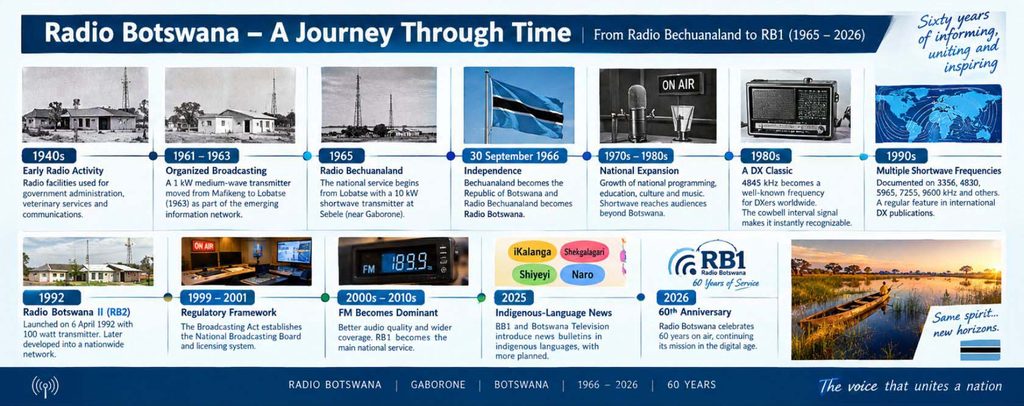
If we compress six decades into a single timeline, the transformation is remarkable:
| Period | Development |
| 1940s | Early radio activity and wartime communications |
| 1961–63 | Development of organized government broadcasting |
| 1965 | Radio Bechuanaland develops as a national service |
| 1965 | Shortwave facilities established at Sebele |
| 30 Sept 1966 | Bechuanaland becomes independent Botswana |
| 1966 | Radio Bechuanaland becomes Radio Botswana |
| 1970s–80s | Expansion of national broadcasting and shortwave |
| 1980s | 4845 kHz becomes a classic DX frequency |
| 1990s | Multiple shortwave frequencies documented internationally |
| 1992 | Radio Botswana II launches |
| 1997 onward | Botswana's radio sector becomes more competitive |
| 1999–2001 | Broadcasting regulatory framework introduced |
| 2000s–2010s | FM becomes increasingly dominant |
| 2025 | Indigenous-language news expansion |
| 2026 | Radio Botswana celebrates 60 years |
This is not simply a broadcasting timeline.
It is a technological history of Botswana itself.
A Final Thought from the Shortwave Dial
There was a special kind of excitement in listening to African domestic stations during the great shortwave era.
You were not necessarily looking for the strongest signal.
You were looking for the unexpected - turned the tuning knob slowly.
Waited.
You listened through atmospheric noise.
And then a distant voice appeared.
Sometimes it was only a few minutes.
Sometimes the signal disappeared almost immediately.
But those few minutes could create a memory lasting decades.
Radio Botswana was one of those stations.
Its old frequencies may now be silent, but the recordings remain. The QSL cards remain. The memories of DXers remain. And, most importantly, Radio Botswana itself continues broadcasting to the people of the country it helped connect.
In 2026, as RB1 celebrates six decades on the air, it is worth remembering that this journey began with relatively modest transmitters and a young nation searching for its own voice.
For the people of Botswana, that voice became part of everyday life.
For the international DX community, it became something else:
a distant African voice hiding in the static, waiting patiently to be discovered.
And somewhere in the memory of an old shortwave listener, there may still be those unmistakable sounds:
cowbells in the African night, followed by the voice of Radio Botswana. That is why Radio Botswana deserves its place in the history of international shortwave listening.
Sources and research notes
The historical account above draws particularly on
- Botswana government records,
- Statistics Botswana's 2022 census material,
- academic research into Botswana's broadcasting history,
- historical Monitoring Times frequency information, and
- surviving Radio Botswana recordings.
- Wikipedia
- DX Blogs
The 2026 anniversary information is especially current, with Botswana's government newspaper documenting the station's 60th anniversary activities.