
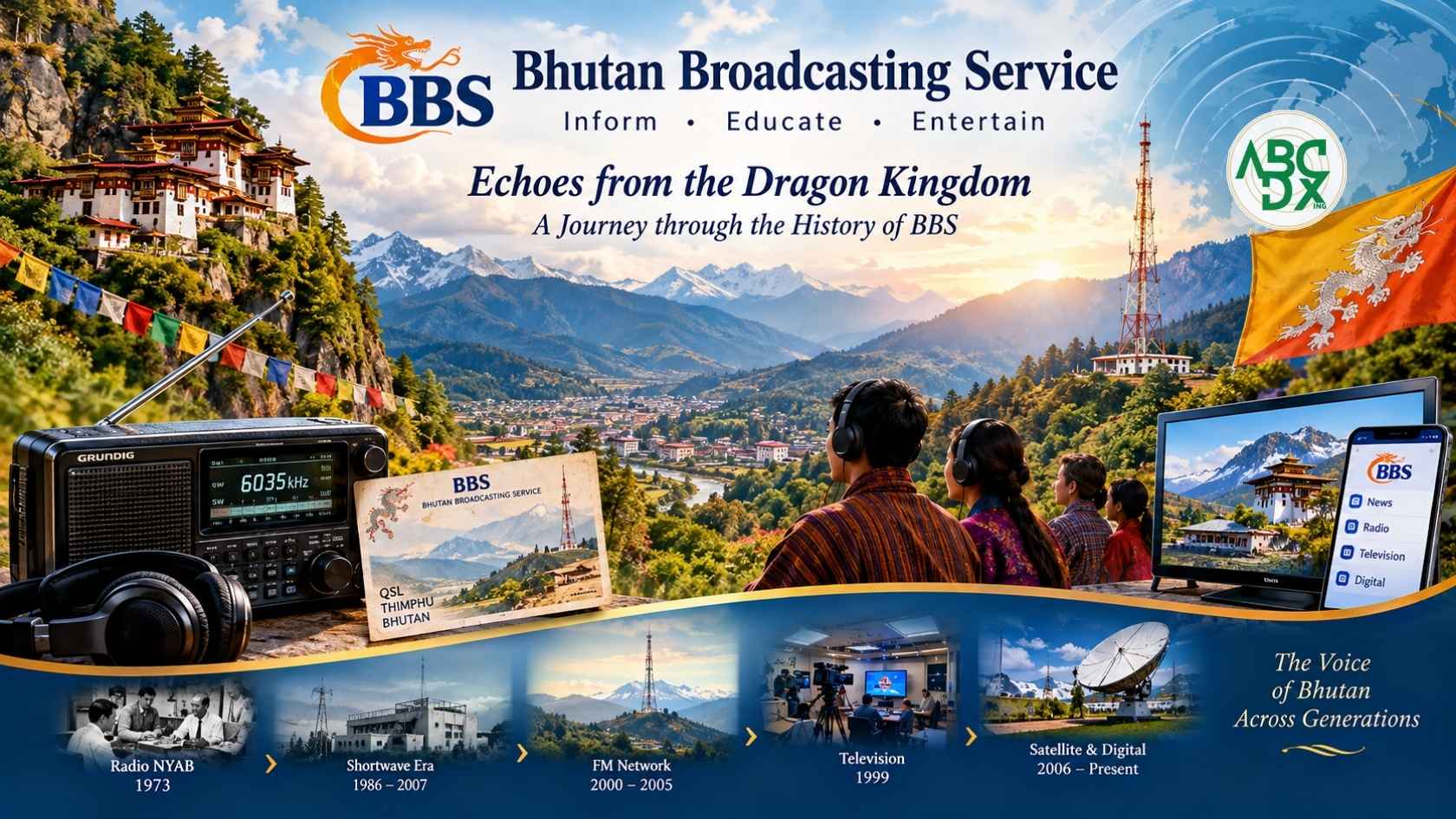

The Bhutan Broadcasting Service, or BBS, belongs to that rare group. Its journey began modestly in 1973 with a borrowed transmitter and a group of young enthusiasts. More than five decades later, BBS has developed into Bhutan's national public broadcaster, operating across radio, television and digital platforms.
From a borrowed 400-watt transmitter in 1973 to a modern public broadcaster reaching Bhutan through radio, television and digital media. There are radio stations remembered because of their enormous transmitters. People remember others for their famous international services, distinctive interval signals, or legendary frequencies. Then there are stations remembered for something more difficult to measure: they become part of the story of the country they serve.
For DXers, however, BBS has always had another attraction. For many years, its shortwave transmissions carried the sound of Bhutan far beyond the Himalayas. A signal that began its journey in Thimphu could suddenly appear in a listening room thousands of kilometres away. For the listener, it was not simply a radio transmission. It was a brief window into Bhutan.
Today, the broadcasting landscape has changed. BBS has moved strongly toward FM, television and digital media, while its famous shortwave service has become part of broadcasting history. Yet the story of those shortwave signals remains an important chapter in the history of Asian radio.
This is the story of Bhutan Broadcasting Service.
A Radio Station Born from Enthusiasm
The story began on 11 November 1973, when Bhutan had no national broadcasting service in the modern sense. A group of young, Western-educated university graduates believed radio could play an important role in connecting the country and sharing information. They formed the National Youth Association of Bhutan, known as NYAB, and decided to take their idea to the airwaves.
Their resources were extremely limited. The group borrowed a 400-watt civil wireless transmitter and established a small broadcasting operation. There was no powerful national network and no sophisticated broadcasting complex. Yet on that November day, a new voice emerged from Bhutan.
The station was called Radio NYAB. At first, it broadcast for only 30 minutes every Sunday, and the programmes were in English. By today's standards, half an hour a week seems almost impossibly small. In Bhutan of the early 1970s, however, those thirty minutes represented the beginning of a completely new chapter in national communication.
The following year brought the first expansion. BBS added another thirty minutes, this time in Dzongkha, Bhutan’s national language. The change was significant because Radio NYAB was beginning to reflect the people it served rather than simply functioning as an experiment in broadcasting.
The young station was finding its voice.
From Radio NYAB to a National Service
Radio NYAB gradually demonstrated that radio could serve a much wider national purpose. In 1979, the station came under the Department of Information and Broadcasting, bringing it into the government's developing communications structure. Airtime increased to nine hours a week, with programs broadcast on Sundays, Wednesdays and Fridays.
There was an unusual practical reason why the station could not broadcast every day. On Mondays, Tuesdays and Thursdays, the Bhutanese government and the Royal Bhutanese Embassy in Dhaka, Bangladesh, used the civil wireless transmitters for official communication. The same equipment therefore served both broadcasting and diplomatic communication.
For modern listeners, accustomed to multiple transmitters and instant digital communication, this arrangement seems almost unimaginable. A single piece of equipment had to carry both the voice of a young radio service and important government messages across national borders.
In 1980, Radio NYAB broadened its linguistic reach once again by introducing Tshanglakha and Lhotshamkha. Radio was gradually becoming a national platform capable of reaching different linguistic communities across Bhutan.
The transformation from a small youth initiative into a national broadcasting service had begun.
1986: The Birth of Bhutan Broadcasting Service
A decisive milestone came in 1986, when Radio NYAB was formally renamed the Bhutan Broadcasting Service. The change in name reflected a much larger transformation taking place behind the scenes.
The original 400-watt civil wireless transmitter replaced by a 10-kilowatt shortwave transmitter, and broadcasting became available daily. For a mountainous country with scattered settlements and difficult terrain, this was an important technical development.
Shortwave offered something that local transmission systems could not easily provide. Its signals could travel considerable distances and reach communities separated by mountains and valleys. It became a natural tool for expanding the national reach of Bhutanese broadcasting.
For the DX community, the emergence of BBS as a regular shortwave broadcaster would eventually create an entirely different kind of audience. Listeners outside Bhutan began discovering the country through their receivers, often without ever having visited it.
The 50-Kilowatt Era
The next major development came in 1991, when BBS acquired a considerably more powerful 50-kilowatt shortwave transmitter. In the same year, the broadcaster moved into its present headquarters in Thimphu.
The technical upgrade came at an important period in Bhutan's development. Radio was becoming increasingly important as a means of connecting the country's communities, while BBS itself was developing into a more professional national broadcasting organisation.
Then came a major institutional change. In 1992, His Majesty the Fourth King issued a Royal Kasho granting BBS full autonomy and delinking it from the Ministry of Information and Communication. This marked an important step in the broadcaster's development and strengthened its position as an autonomous public broadcasting organisation.
By this point, the little operation that had begun with a borrowed 400-watt transmitter two decades earlier had become a national broadcaster with modern shortwave facilities and a growing institutional identity.
When the Voice of Bhutan Reached the DX World
For shortwave listeners, the 1990s and 2000s were an especially interesting period. BBS became a recognised presence on the international shortwave bands, and 6035 kHz, in the 49-metre band, became one of the frequencies most strongly associated with the Bhutanese broadcaster.
For DXers, however, hearing BBS was never simply a matter of turning on a receiver and waiting for a strong signal. Propagation conditions, atmospheric noise, interference and fading could all determine whether the Bhutanese signal appeared clearly or disappeared into the noise.
That uncertainty was part of the attraction.
A listener might hear only fragments at first. Perhaps a piece of Bhutanese music would emerge from the static, followed by a few words in Dzongkha. On another occasion, an English announcement might suddenly become clear before the signal faded again.
When the reception was good, the experience was special. The listener was no longer simply looking at Bhutan on a map. The country had become a sound in the room. Historical DX reports document reception of BBS across parts of South Asia and Europe, while specialist monitoring records from the period provide valuable evidence of the station's shortwave activity. For collectors and enthusiasts today, these old logs and QSL cards preserve an important part of Bhutan's international radio history.
The 100-Kilowatt Shortwave Chapter
In 2007, BBS took another major technical step by inaugurating a new 100-kilowatt Thomson TSW 2100D shortwave transmitter at Sangaygang near Thimphu. Designed with Digital Radio Mondiale (DRM) capability, the transmitter was installed with financial assistance from the Government of India.
For shortwave enthusiasts, this was exciting news. A Bhutanese national broadcaster equipped with a 100-kilowatt transmitter represented a significant increase in technical capability and raised the possibility of reception over much greater distances.
DX reports from this period recorded BBS reception in distant parts of the world. The station was no longer merely a regional curiosity. Under favourable propagation conditions, its signal could become a genuinely international DX catch.
Yet shortwave broadcasting has never been only about transmitter power. Antenna systems, propagation conditions, maintenance and frequency management all affect the final reception. BBS experienced technical difficulties with its high-powered transmitter at different times, reminding listeners that even a powerful shortwave facility depends on a complex chain of engineering and atmospheric factors.
For those who followed BBS during this period, however, the 100-kilowatt transmitter became another memorable chapter in the station's technical history.
FM Brings a New Era to Bhutan Broadcasting
While shortwave was carrying Bhutanese programmes across long distances, another transformation was taking place inside the country. BBS began developing a nationwide FM network, recognising that FM could provide clearer audio and more practical local coverage than shortwave.
The nationwide FM project began in 2000. The network was expanded progressively across different parts of the country, and by 2005, FM service had become available nationwide.
For everyday listeners, the difference was substantial. FM offered cleaner sound, less interference and a more convenient listening experience. People could listen at home, in vehicles and in their communities without having to deal with the fading and interference that often accompany shortwave reception.
The geography of Bhutan made the development particularly important. A network of FM transmitters could be positioned to serve individual valleys and communities, allowing BBS to bring its programmes much closer to its listeners.
The expansion did not mean that the history of shortwave suddenly became irrelevant. Instead, it marked a gradual change in the role of radio technology. Shortwave had helped BBS overcome geographical distance, while FM allowed the broadcaster to build a stronger domestic network.
More Hours, More Languages, More Listeners
BBS continued to expand its programming during the early years of the new century. The morning broadcast was introduced on 11 November 2000, and weekly airtime reached 63 hours. Daily programming was subsequently increased to 12 hours in 2003 and then to 15 hours in 2004.
The linguistic character of BBS remained equally important. Programming developed in Dzongkha, English, Lhotshamkha and Tshangla, allowing the broadcaster to communicate with different communities across the country.
In 2013, BBS introduced a dedicated Dzongkha radio channel. Radio operations eventually developed into a round-the-clock service, giving Bhutanese audiences continuous access to national broadcasting.
The contrast with 1973 is remarkable. The original Radio NYAB had offered only thirty minutes of English programming on a Sunday. Four decades later, BBS had become a 24-hour broadcaster serving a multilingual national audience.
Television Comes to Bhutan Broadcasting
Radio was only the beginning of the BBS story.
On 2 June 1999, Bhutan entered the television age when BBS launched television broadcasting. The date coincided with the silver jubilee celebrations of the reign of His Majesty the Fourth King.
The early television operation was extremely different from today's digital environment. News programs were initially recorded on VHS tapes, and in some cases recordings had to travel by bus to reach viewers in distant parts of Bhutan.
Imagine the contrast.
Today, a television program can be produced in Thimphu and streamed instantly around the world. In the early days of BBS television, a recorded news program could physically travel across the country before some viewers were able to watch it.
That period illustrates just how rapidly Bhutan's communications infrastructure developed.
BBS gradually modernized its television production, moving from analogue equipment and videotape toward digital production systems. Satellite technology also expanded the broadcaster's reach, and nationwide satellite television service was launched in 2006.
The television operation continued to grow, eventually developing additional channels and a much broader range of news, cultural, educational and entertainment programming.
From Analogue Broadcasting to HD
The transformation continued through the 2010s and 2020s.
BBS invested in digital production facilities, satellite distribution and modern television infrastructure. The broadcaster also expanded its online presence, allowing audiences to access news and programmes without depending on a traditional radio or television receiver.
The change is perhaps most visible when comparing the technical environment of the early BBS years with the present day. The organisation that once relied on a borrowed wireless transmitter and VHS recordings has moved into modern digital production and high-definition broadcasting.
In 2026, BBS reported its transition from standard-definition to high-definition television transmission, another significant step in its continuing technological development.
The journey from analogue equipment to HD is not merely a story about machines. It reflects the extraordinary transformation of Bhutan's communications environment over little more than five decades.
Bhutan Broadcasting Service in the Digital Age
The modern BBS is no longer confined to the radio receiver or television set. Its website and digital platforms allow Bhutanese audiences and people outside the country to follow news, features, videos and other content from almost anywhere.
BBS describes its vision as “A trusted public service broadcaster”, with a mission focused on informing, educating and entertaining society through diverse Bhutanese content.
That mission can be seen across its output. News and current affairs remain central, but BBS also covers culture, education, agriculture, health, environment, development, sports and human-interest stories.
The platforms may have changed, but the fundamental purpose remains familiar. BBS continues to connect the centre of the country with communities across Bhutan while also presenting Bhutanese life to the outside world.
The digital transformation is still continuing. In 2026, BBS announced work on a new online platform, demonstrating that the broadcaster is still adapting to the rapidly changing habits of modern audiences.
What Happened to BBS Shortwave?
This is perhaps the most important question for today's DXers.
Older frequency guides and reception reports often mention 6035 kHz as the famous BBS shortwave frequency. The frequency remains strongly associated with the station in the memories of international shortwave listeners.
However, historical information should not be confused with a current schedule.
Recent specialist shortwave references report BBS as inactive on shortwave, with the last widely reported regular reception dating from 2020. Current monitoring should therefore be checked before anyone goes searching for BBS on the old frequencies.
For today's DXer, 6035 kHz is best regarded as a historic BBS frequency, not a dependable current transmission frequency.
That does not make the frequency less interesting.
Quite the opposite.
For anyone who collected BBS QSL cards, wrote reception reports or spent evenings searching the 49-metre band for a faint Bhutanese signal, 6035 kHz remains a small piece of radio history.
Why BBS Became Special to DXers
There were always more powerful stations on the shortwave bands. International broadcasters in Europe, Asia and North America operated transmitters far larger than those used by BBS.
So why did DXers care about Bhutan?
Because BBS offered something that transmitter power could never provide: the excitement of discovery.
Finding a relatively elusive national broadcaster from a Himalayan kingdom was an achievement. It required patience, knowledge of frequencies and propagation, and sometimes a little luck.
A strong signal was wonderful, but a weak signal could be even more memorable.
The experience might begin with static. Then a few syllables would emerge. Perhaps music would follow. The signal might fade before the listener could identify it. Ten minutes later, it might return stronger than before.
This is the magic of shortwave DXing.
You are not simply listening to a station.
You are waiting for the world to reveal itself. For many DXers, BBS did exactly that.
QSL Cards and the Memory of a Lost Signal
A confirmed reception from BBS has always held a special place in any DX collection. A QSL card, verification letter, or reception report offers tangible proof that, thousands of kilometers away, a listener once heard the voice of Bhutan.
Today, these mementos carry an even greater historical significance. They preserve the memory of an era that has largely vanished from the shortwave bands.
A QSL from BBS is therefore far more than a collector’s item. It can capture the frequency, date, program, transmitter, and listening conditions of one precise moment in broadcasting history.
For a DXer, that small card can bring an entire evening back to life: the antenna outside the window, the headphones resting over the ears, the signal fading in and out, and the notebook lying beside the receiver.
Then, at last, the words every DXer desires to see: Bhutan confirmed.
Bhutan Broadcasting Service: More Than a Radio Station
It would be easy to describe BBS simply as Bhutan's national broadcaster. That description is correct, but it does not fully explain its importance.
BBS developed alongside modern Bhutan itself. When
- Communication between distant communities was difficult, radio provided a vital connection
- Television finally arrived, BBS carried the country into a new media era.
- FM expanded across the mountains, the broadcaster followed its listeners into a new generation of radio.
Later came satellite television, digital production, online news and streaming.
The technology changed repeatedly, but the basic purpose remained remarkably stable: to inform, educate and entertain Bhutanese society while preserving and presenting the country's identity.
That continuity is perhaps the most impressive part of the BBS story.
The Human Story Behind the Signal
For a radio historian, the most fascinating part of BBS may not be the 100-kilowatt transmitter or the modern digital newsroom.
It may be the beginning.
Imagine the young university graduates who gathered in 1973 with an idea, a borrowed 400-watt transmitter and almost no precedent to follow.
BBS had only thirty minutes on a Sunday, yet they believed those thirty minutes mattered.
They could not have known that their little experiment would eventually become Bhutan's national broadcaster.
Bhutan could not have imagined the later FM network, television channels, satellite services, online platforms or HD transmission.
Yet all of those developments can be traced back to that first broadcast.
This is why the history of radio is ultimately a human story.
Technology provides the means. People give the signal its meaning.
From 400 Watts to the Digital World

The history of Bhutan Broadcasting Service can be viewed as a remarkable technological timeline:
| Year | Milestone |
| 1973 | Radio NYAB begins with a borrowed 400-watt transmitter |
| 1974 | Dzongkha programming is added |
| 1979 | Radio NYAB comes under the Department of Information and Broadcasting |
| 1980 | Tshanglakha and Lhotshamkha are introduced |
| 1986 | Radio NYAB becomes Bhutan Broadcasting Service |
| 1991 | BBS acquires a 50-kilowatt shortwave transmitter and moves to its present headquarters |
| 1992 | A Royal Kasho grants BBS autonomy |
| 1999 | BBS television begins |
| 2000 | Nationwide FM project begins |
| 2005 | FM coverage becomes nationwide |
| 2006 | Nationwide satellite television service begins |
| 2007 | A 100-kilowatt DRM-capable shortwave transmitter is inaugurated |
| 2012 | BBS TV Channel II begins |
| 2013 | Dedicated Dzongkha radio channel is introduced |
| 2020s | BBS expands its online and digital presence |
| 2026 | BBS continues its transition toward HD and new digital platforms |
The details of some historical milestones vary slightly between sources, particularly in older transmitter and scheduling records. For that reason, historical BBS information should always be read with the date of the source in mind.
The Voice That Came from the Mountains
The history of Bhutan Broadcasting Service is, above all, a story of transformation.
It began with a borrowed transmitter and just thirty minutes of programming. From those modest beginnings, it grew through shortwave, powerful transmitters, FM networks, television, satellite distribution, and digital media.
- Technology has changed.
- The audience changed.
- The way people listened changed.
Yet the fundamental idea remained constant: Bhutan needed a voice capable of connecting its people and sharing its story with the world.
For today’s audience, that voice may arrive through FM radio, television, a website, or a smartphone. But for the traditional DXer, BBS will always carry another identity.
It will be the faint signal rising from the static.
Unexpected voice from the Himalayas.
Unfamiliar music that suddenly begins to make sense.
The station identification confirming what the listener had hoped to hear.
And, perhaps years later, the QSL card preserved inside a treasured DX collection.
That is the enduring magic of radio.
- Signal may fade.
- Transmitter may fall silent.
- Frequency may eventually be reassigned.
But the memory of hearing a distant country for the first time can remain for a lifetime.
For generations of shortwave listeners, Bhutan Broadcasting Service became that memory. It was a voice from the Dragon Kingdom—a voice that crossed the shortwave bands, travelled beyond the Himalayas, and found its way into listening rooms around the world.
Although its celebrated shortwave chapter now belongs largely to history, the story of BBS continues.
- The transmitter may have changed.
- The medium may have changed.
- But the voice of Bhutan is still on the air.
Why Remembering Bhutan Broadcasting Service on Shortwave
Historic shortwave frequency: 6035 kHz, 49-metre band
Major historic transmitter site: Sangaygang, near Thimphu
Historic transmitter development: 10 kW, 50 kW and later 100 kW DRM-capable equipment
Historically heard languages: Dzongkha, English, Lhotshamkha and Tshangla
Current shortwave status: Recent specialist DX references report BBS as inactive on shortwave. Only FM channels are active now. For DXers and collectors, the old BBS frequencies remain worth exploring through archived logs, QSL collections and historical reception reports. These records preserve a fascinating period when one of Asia's most distinctive national broadcasters could be discovered far beyond the borders of Bhutan.