
When Radio Canada International Spoke to the World
There are radio stations.
There are international broadcasters.
And then there are legends.
For generations of shortwave listeners, Radio Canada International (RCI) belonged to that rare category of broadcasters that became much more than a radio station. It was a trusted companion, a cultural ambassador, a reliable source of news, and for countless DXers, one of the first international signals ever logged.
Many stations have come and gone from the shortwave bands. Frequencies have changed. Transmitters have fallen silent. Entire services have disappeared from the airwaves.
Yet even today, years after its departure from shortwave, the name Radio Canada International still evokes memories of warm voices, powerful signals, beautiful QSL cards, and a uniquely Canadian perspective on world events.
This is the story of RCI—from its wartime birth to its golden era, through its struggles, and finally to the heartbreaking silence that ended one of the world’s most respected international broadcasting services.
A Voice Born During World War II
The origins of RCI can be traced back to the darkest years of the Second World War.
In September 1942, the Canadian government approved plans for an international shortwave broadcasting service. The original purpose was straightforward: provide news and information to Canadian troops serving overseas and strengthen Canada’s voice among the Allied nations.
The service officially began broadcasting on 25 February 1945.
Listeners around the world heard the voice of Canadian Prime Minister W. L. Mackenzie King, who welcomed audiences to Canada’s new international radio service. At that moment, Canada joined the ranks of nations using shortwave radio to reach beyond their borders.
The studios were established in Montreal.
The transmitters were built in Sackville, New Brunswick.
It was a partnership that would define Canadian international broadcasting for nearly seven decades.
Why Sackville Became Famous
To many DXers, the name “Sackville” became almost as famous as Radio Canada International itself.
Located on the Tantramar Marshes of New Brunswick, the transmission site offered exceptional propagation toward Europe, Africa, Latin America, and parts of Asia. Engineers carefully selected the location after extensive studies of radio paths across the Atlantic. Reports at the time suggested that the site produced some of the strongest international signals originating from North America.
Over the decades, the site evolved into one of the most sophisticated shortwave facilities in the world.
Massive curtain arrays stretched across the horizon.
Tower structures dominated the landscape.
High-power transmitters sent Canada’s voice across continents and oceans.
For radio enthusiasts driving through New Brunswick, the forest of antennas was a breathtaking sight. It symbolized Canada’s global presence on the airwaves.
The Golden Age of Radio Canada International
The decades following World War II marked the rise of RCI as a major international broadcaster.
The Cold War dramatically increased the importance of shortwave radio. Nations competed not only militarily and politically but also through information and ideas.
RCI offered something distinctive.
Unlike many state broadcasters, it developed a reputation for balanced reporting, thoughtful programming, and cultural diplomacy.
Its mission was not simply to promote government policies. It aimed to present Canada to the world.
Programs covered:
- Canadian politics
- International affairs
- Science and technology
- Indigenous cultures
- Music and arts
- Immigration and multiculturalism
- Listener correspondence
RCI gradually expanded into multiple languages and eventually served audiences across every major region of the globe. By 1990, the service operated in fourteen languages and employed roughly two hundred staff members.
Radio Canada became a valuable alternative source of information for many listeners behind political barriers.
For immigrants preparing to move to Canada, it provided insight into Canadian society. For DXers, it was one of the most reliable stations on the dial.
The Era of Listener Clubs and QSL Cards
Perhaps no aspect of RCI is remembered more fondly than its relationship with listeners.
The station understood radio hobbyists.
Reception reports were welcomed.
Letters were answered.
Beautiful QSL cards were issued. Special publications, stickers, pennants, and listener materials arrived in mailboxes around the world.
Long before social media existed, RCI built a global community through traditional correspondence. Many DXers still treasure RCI verification cards as prized pieces of their collections.
In countless radio clubs around the world, receiving a reply from Montreal was considered a badge of honour.
Radio Canada International: A Signal Heard Everywhere
RCI’s engineering reputation became legendary.
Its signals were often among the strongest on the international bands.
The Sackville facility eventually operated multiple high-power transmitters and one of the world’s most capable antenna systems.
The site was so effective that numerous international broadcasters leased transmission time there.
Over the years, the facility carried programming from broadcasters such as:
- NHK World Radio Japan
- China Radio International
- Voice of Vietnam
- BBC World Service
- Deutsche Welle
- Radio Korea International
Sackville became a strategic international broadcasting hub, not merely a Canadian facility.
The Internet Changes Everything
The arrival of the Internet transformed international broadcasting.
Governments around the world began questioning the value of expensive shortwave services.
Audiences increasingly consumed information online.
Budget pressures grew.
Many historic broadcasters reduced frequencies, closed language sections, or abandoned shortwave altogether.
RCI was not immune.
Throughout the 1990s and 2000s, language services were reduced and resources became increasingly limited. The end of the Cold War also weakened the political justification for maintaining large international broadcasting operations.
Yet despite the challenges, many listeners believed RCI would survive.
After all, Canada had maintained an international voice for generations.
Surely it would continue.
The Shock of 2012
Then came the announcement.
In 2012, Radio Canada International suffered an approximately 80 percent budget reduction.
The consequences were devastating.
Shortwave broadcasting would end.
Satellite services would end.
Most staff positions would disappear.
Newsroom operations would be dismantled.
RCI would become an Internet-only service.
The news spread rapidly through DX clubs, mailing lists, and radio forums.
Listeners around the world reacted with disbelief.
Many had expected reductions.
Few expected near destruction.
The Final Broadcast of Radio Canada International
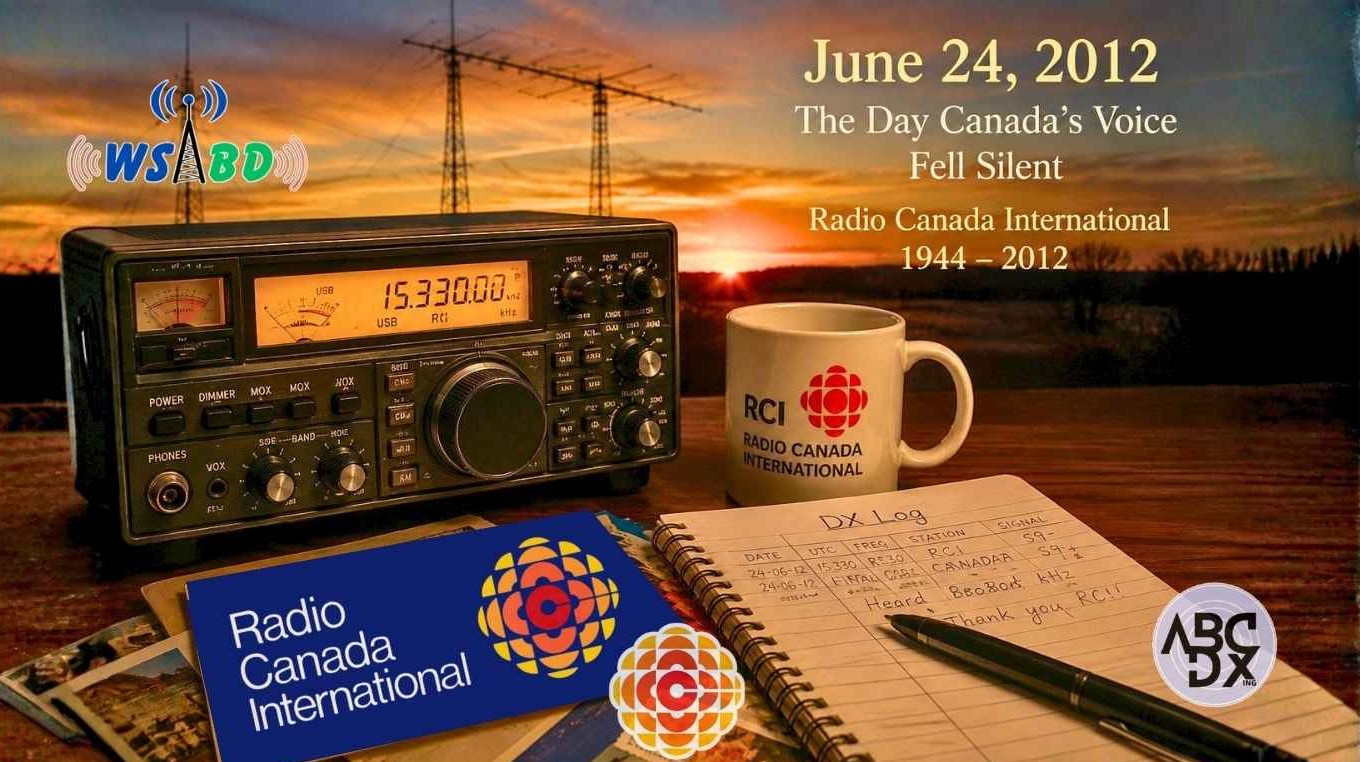
On 24 June 2012, the final shortwave transmissions left the Sackville transmitter site.
After sixty-seven years of international broadcasting, Radio Canada International’s voice faded from the shortwave spectrum.
For many listeners, the last days were deeply emotional.
Hosts who had spent decades speaking to international audiences said farewell.
Listeners recorded the final broadcasts.
Reception reports arrived one last time.
Across the world, radio enthusiasts tuned in simply to hear history being made.
Some listened from sophisticated communications receivers.
Others listened on portable radios with a simple wire antenna.
The equipment hardly mattered.
What mattered was witnessing the end of an era.
The Fall of Sackville
The silence did not stop with the broadcasts.
Soon the future of the Sackville transmission site itself became uncertain.
Efforts were made to find buyers.
None emerged.
The giant antennas that once carried Canada’s voice around the globe were eventually dismantled.
Tower after tower disappeared from the skyline.
For former employees and radio enthusiasts, watching the structures come down was heartbreaking.
A landmark of global broadcasting history vanished piece by piece.
Today, little remains to remind visitors that one of the world’s great shortwave stations once stood there.
Why Radio Canada International Still Matters
Some may argue that international broadcasting simply moved online.
Technically, that is true.
But shortwave radio was never just a delivery platform.
It was accessibility.
SW was resilience.
It was independence from local infrastructure.
A shortwave signal could cross borders, oceans, political systems, and technological limitations.
A listener needed only a radio.
No subscription.
No broadband connection.
Not any app.
Even no gatekeeper.
RCI understood this principle better than most.
That is why its disappearance continues to resonate among radio enthusiasts worldwide.
Remembering the Voice of Canada
Today, younger listeners may know Radio Canada International only through archives and historical references.
Older DXers remember something more personal.
They remember tuning across the bands late at night.
Remember hearing “This is Radio Canada International.”
They remember receiving a QSL card after weeks of waiting.
They remember the excitement of logging a powerful signal from Sackville.
Most of all, they remember a broadcaster that treated its listeners as friends.
Radio Canada International may have left shortwave.
Its antennas may be gone.
Its frequencies may be silent.
But among generations of listeners, the Voice of Canada continues to echo across the airwaves of memory.
And for those who grew up with shortwave radio, that signal will never truly fade away.
Final Thoughts
The story of Radio Canada International is not merely the story of a broadcaster.
It is the story of an era when nations spoke to the world through radio.
It is the story of engineers, journalists, presenters, and listeners connected by invisible waves travelling across the globe.
And it is a reminder that while technology changes, the human desire to communicate across borders remains timeless.
For millions of listeners, Radio Canada International was more than a station.
RCI was a companion.
It was a classroom.
RCI was a window to Canada.
And it remains one of the greatest chapters ever written in the history of international shortwave broadcasting.