
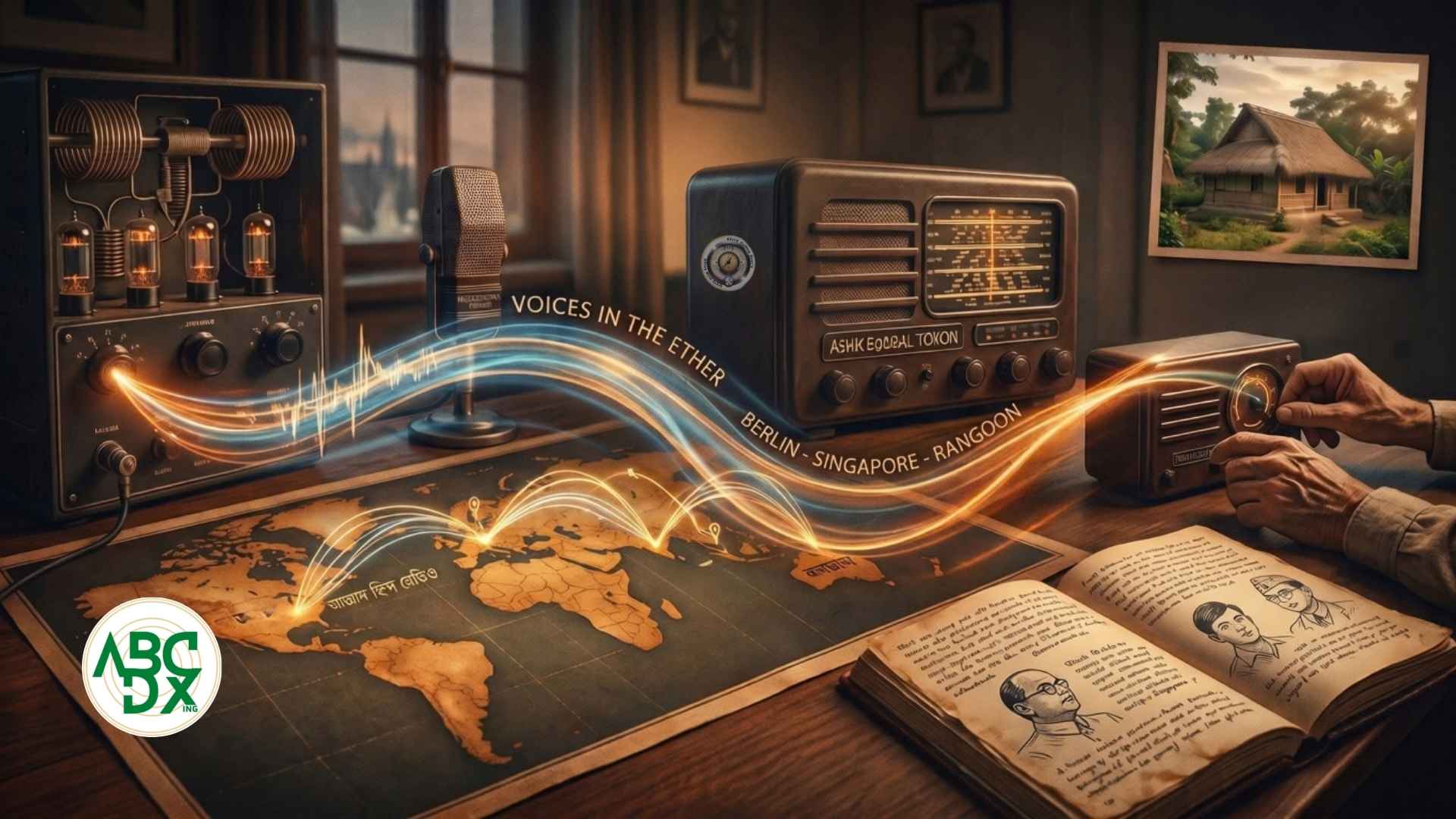

We often spend quiet late hours tuning across the shortwave bands. Radio is far more than just a receiver sitting on a desk. It is an ocean of hidden history. Beneath the static and distant carrier tones lies a golden age of broadcasting. High-frequency radio was once a vital tool for human liberation. Among all chapters in radio history, Netaji Subhas Chandra Bose stands out. His work carries raw emotional power and strategic genius. Long before digital networks existed, Netaji understood the power of shortwave radio. It could penetrate guarded borders and bypass colonial censorship. It awakened the spirit of millions.
A Voice Breaking Through Imperial Propaganda
Netaji made his legendary escape from house arrest in Kolkata in January 1941. He quietly journeyed to Europe while British authorities searched for him. Then, on January 7, 1942, a sudden shortwave transmission shocked British intelligence.
A calm and resolute voice announced through the atmospheric crackle:
"This is Subhas Chandra Bose speaking to you over the Azad Hind Radio."
Those words broadcast from Berlin via shortwave transmitters. They shattered colonial claims that Netaji was captured or killed. Millions listened in secret across India. For them, it was a moment of pure hope.
Netaji understood the psychological power of the airwaves. Imperial powers used state radio to shape narratives. Netaji took the fight directly to them. He dismantled colonial broadcasting with sharp wit. Subhas Chandra Bose labeled the BBC as the "Bluff and Bluster Corporation." He called All India Radio the "Anti-Indian Radio." Every broadcast opened with iconic poetic lines by Bahadur Shah Zafar.
The Bridge to Asia: Broadcasting from Radio Tokyo
As the theater of World War II shifted, Netaji undertook a dangerous 90-day submarine voyage from Europe to East Asia in 1943. Upon his arrival in Tokyo, his first major action was once again to step up to a radio microphone.
On June 19, 1943, Netaji broadcast live over the high-power shortwave transmitters of Radio Tokyo (NHK). His message reached across South Asia, informing the world that he was in East Asia to assemble the Indian National Army (INA) and launch a final campaign for independence.
Later, operating shortwave stations from Singapore and Rangoon, Netaji spoke directly to the people of Bengal in their native language. During the tragic Bengal Famine of 1943 and the height of the Quit India Movement, his Bengali radio addresses served as a comforting line of truth, offering solidarity and courage when news was heavily suppressed by wartime censors.
Listening in Secret: The Magic of HF Radio
In those turbulent years, tuning in to Azad Hind Radio or Radio Tokyo was classified as a crime by British authorities. Yet, every evening as the sun went down, families and resistance groups gathered around wooden receiver cabinets. They carefully adjusted the tuning dials, waiting for that familiar signal to rise above the static floor.
Sending a voice thousands of miles across oceans required massive antenna arrays, high-voltage transmitter valves, and favorable ionospheric conditions. But above all, it required a shared belief between the speaker at the microphone and the listener behind the glass dial.
Why Netaji's Radio Legacy Matters Today
We live in a modern age of instant messaging and high-speed internet. It is easy to forget how much courage was carried by radio waves. Netaji proved that an idea could travel on invisible waves. It could overcome oceans, mountain ranges, and heavily armed borders.
We connect to a rich heritage whenever we turn on our receivers today. Shortwave radio was not just technology. It was the voice of resistance and a sanctuary for truth. That beacon of freedom still echoes through time.