

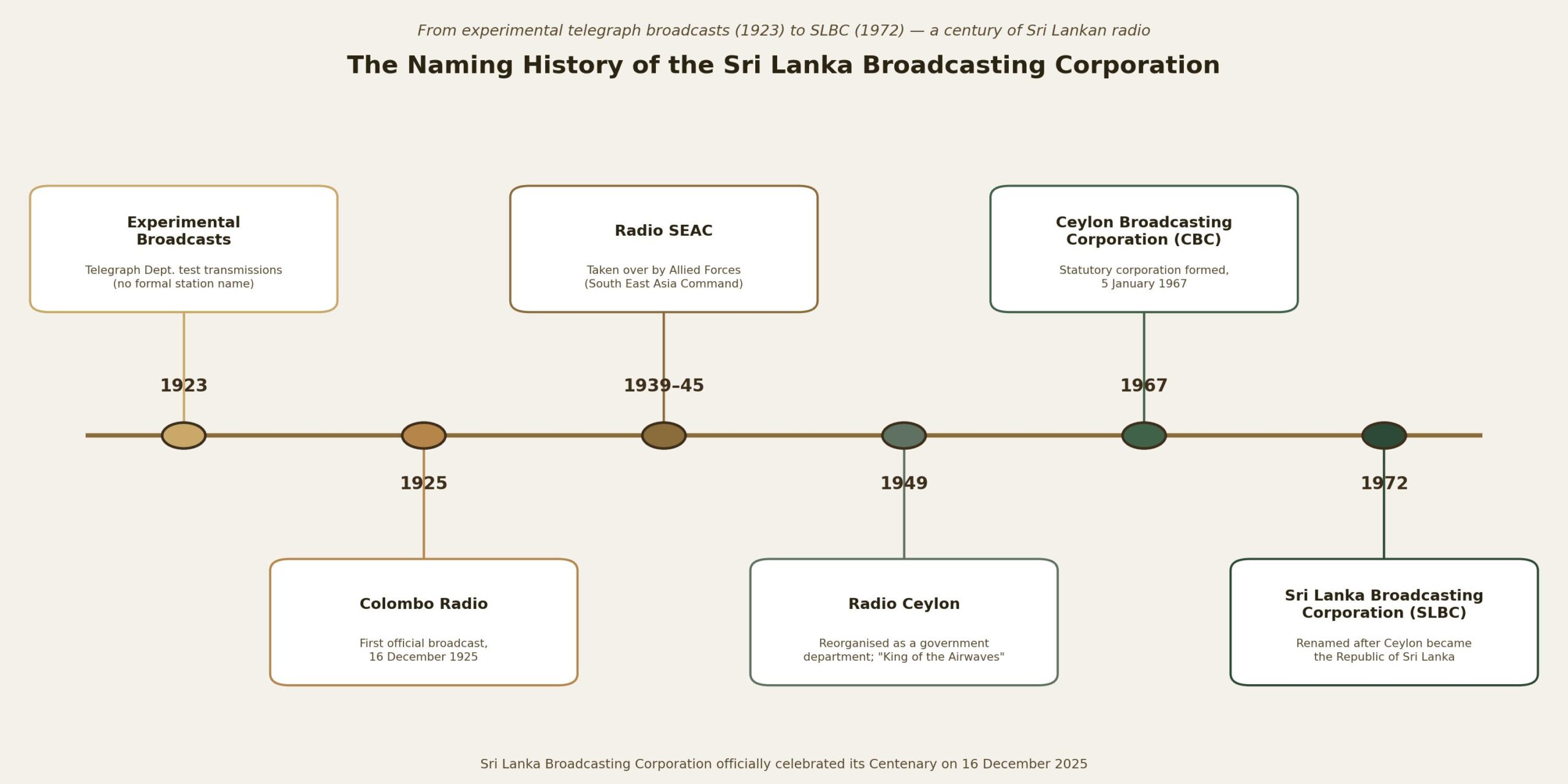
The Sri Lanka Broadcasting Corporation (SLBC) holds a distinctive place in world media history. Known for most of the twentieth century as Radio Ceylon, it is recognized as the first radio station in Asia. It is the second-oldest continuously evolving radio broadcaster in the world, after the BBC. What began in 1923 as an experimental transmission from a colonial telegraph office has grown into a full national broadcasting corporation. Over a hundred years, it has expanded to span medium wave, shortwave, FM, and now digital streaming. This article traces that journey in full — from its earliest engineering origins through its wartime transformation, its "golden age" as the King of the Airwaves in South Asia. Its also the evolution into a modern FM-based public broadcaster, and its centenary in December 2025.
Origins: The Telegraph Department and Edward Harper (1921–1923)
Sri Lanka's broadcasting story begins not with a radio station but with a telegraph office. In July 1921, a British engineer named Edward Harper arrived in Ceylon to take up the post of Chief Engineer, Telegraphs. Harper had a personal fascination with the emerging medium of wireless broadcasting. This technology had only been formally licensed in Britain in 1923 with the founding of the British Broadcasting Company. His enthusiasm proved contagious. He gathered together a circle of British and local wireless enthusiasts and formed the Ceylon Wireless Club. It became the seedbed of the island's broadcasting movement. For this pioneering role, Harper is remembered today as the "Father of Broadcasting in Ceylon."
The first experimental broadcast took place in 1923. It's only four years after Europe's first radio broadcast (The Hague, 1919). Just three years after the BBC itself went on air. Gramophone records played out from the Ceylon Telegraph Office in Colombo. They using a transmitter built by the Department's own engineers. In a detail that broadcasting historians still find remarkable. This transmitter was assembled using radio equipment salvaged from a captured German submarine. This fittingly improvised beginning would lead to what would become a broadcasting powerhouse.
Colombo Radio and the Birth of a National Service (1925–1939)
Encouraged by the success of the experimental transmissions, the Telegraph Department pressed ahead with a permanent service. Colombo Radio formally launched on 16 December 1925. It broadcasted on medium wave from a one-kilowatt transmitter located at Welikada, Colombo.. The British Governor of Ceylon, Sir Hugh Clifford, addressed the nation in the station's inaugural broadcast. It was a moment regarded as one of the defining events in the island's media history.
This placed Ceylon in rare company. It became the first place in Asia. Among the earliest anywhere outside Europe, Britain, the United States, and Germany — to operate a public radio broadcasting service. For over a decade, the station operated as a modest technical offshoot of the Telegraph Department. Gradually building an audience and a body of local programming alongside relayed content. And radio ownership on the island slowly expanded.
War Years: Radio SEAC (1939–1945)
The outbreak of the Second World War transformed Colombo's small radio station into a strategic Allied asset. Ceylon's location made it the natural home for South East Asia Command (SEAC). The Allied forces took direct control of radio operations in Colombo, rebranding the station Radio SEAC. From this station, English-language news and entertainment programmes were beamed across the South-East Asian theatre to Allied troops. Two announcers who cut their broadcasting teeth at Radio SEAC — David Jacobs and Desmond Carrington. They went on to become well-known names at the BBC after the war.
When hostilities ended, the station was formally handed back to the Government of Ceylon. It was at this point that the station adopted a name that would become legendary across South Asia: Radio Ceylon.
Radio Ceylon and the Golden Age (1949–1966)
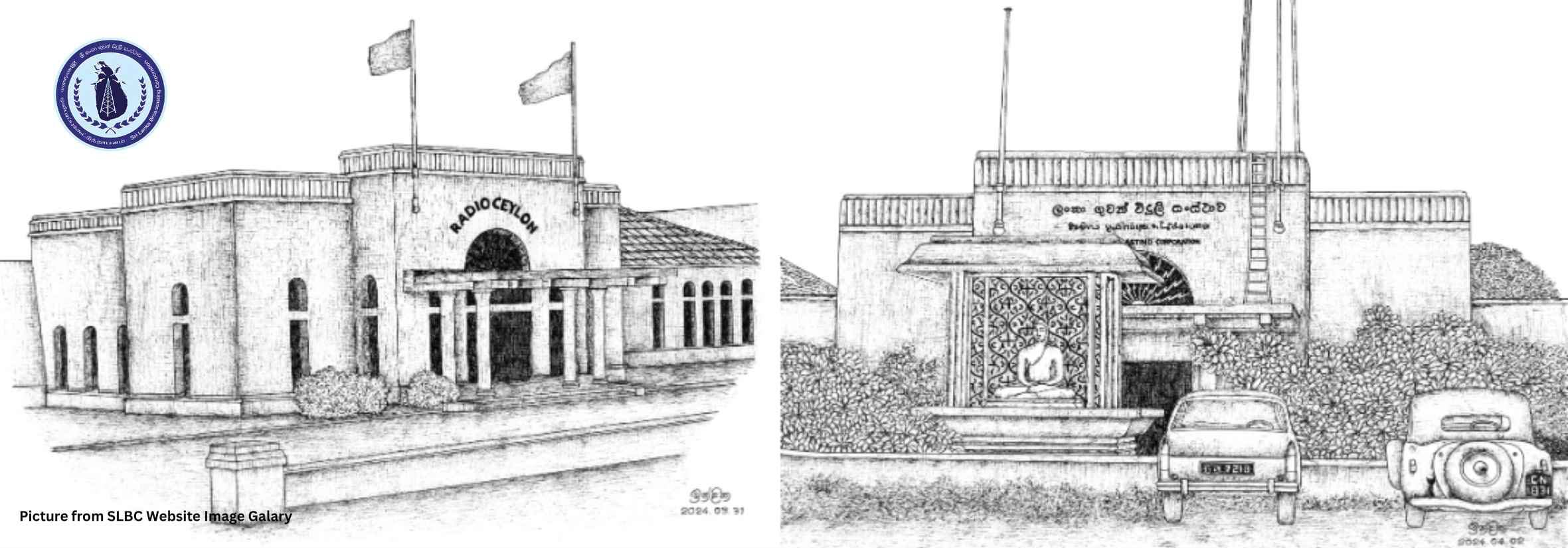
Broadcasting in Ceylon had grown significant enough by 1949, It became a standalone government department. This new department was named the "Radio Service." It operated under the name Radio Ceylon. John A. Lampson served as its first Director.
The 1950s and 1960s are remembered as Radio Ceylon's golden era. During this time, it earned the affectionate title "King of the Airwaves" of South Asia. Several developments fueled this rise:
The Commercial Service. An Australian broadcasting administrator, Clifford Dodd, brought to Ceylon under the Colombo Plan and founded Radio Ceylon's Commercial Service. Quickly it became a runaway commercial success. Ceylonese broadcaster. Livy Wijemanne later became the first local Director of the Commercial Service, having joined the station as an announcer in 1948.
The Hindi Service and cross-border popularity.
It was launched in the early 1950s. Radio Ceylon's Hindi Service capitalized on a curious accident of Indian broadcasting policy: All India Radio had banned film music from its airwaves. Radio Ceylon filled the gap, broadcasting the film songs of icons such as Lata Mangeshkar, Mohammed Rafi, Kishore Kumar, Mukesh, and Asha Bhosle. It had an enormous cross-border Indian audience. At the height of this popularity, it was said that roughly half of all shortwave radios in India were tuned to Radio Ceylon's All Asia Service.
Binaca Geetmala. The station's English-language countdown show. The Binaca Hit Parade (hosted by Greg Roskowski) inspired such listener demand for a Hindi-film equivalent. The station launched Binaca Geetmala in 1952 — one of the most beloved countdown programs in South Asian radio history. Later, it associated with the broadcaster Ameen Sayani.
Advertising power. Radio Ceylon became a magnet for major international brands. From Lux soap to Coca-Cola, whose jingles performed live on air by the station's announcers. It was a testament to its commercial reach across the subcontinent.
Legendary announcers. The station built a roster of announcers whose voices became household names across South Asia. It included Vernon Corea, Pearl Ondaatje, Jimmy Bharucha, Thevis Guruge, Karunaratne Abeysekera, Chitrananda Abeysekera, and many others.
This era also saw the expansion of shortwave transmission from the Ekala relay station near Ja-Ela. By October 1950, it was carrying the Commercial Service to audiences well beyond Ceylon's shores. The Seventh-day Adventist Church became its very first shortwave sponsor. Ekala would remain the technical backbone of Radio Ceylon's international shortwave voice for decades.
Becoming a Corporation: Ceylon Broadcasting Corporation (1967)
By the mid-1960s, the government judged that the state broadcasting department needed greater autonomy and administrative flexibility to keep pace with its growth. Parliament passed the Ceylon Broadcasting Corporation Act No. 37 of 1966. It converted the Department of Broadcasting into a statutory public corporation.
On 5 January 1967, Prime Minister Dudley Senanayake, together with Minister Ranasinghe Premadasa, formally opened the newly created Ceylon Broadcasting Corporation (CBC). Neville Jayaweera, a senior Ceylon Civil Service officer, was appointed the corporation's first Chairman and Director-General. The founding Board of Directors consisted of Jayaweera, A. L. M. Hashim, Dharmasiri Kuruppu, K. A. G. Perera, and Devar Surya Sena.
Sri Lanka Broadcasting Corporation: A New Name for a New Republic (1972)
When Ceylon became the Republic of Sri Lanka on 22 May 1972, the corporation was renamed once more. It is the name it still carries today: the Sri Lanka Broadcasting Corporation (SLBC). It has operated under this name, and under the same basic legal structure as a state corporation, ever since. SLBC is currently sitting under the purview of Sri Lanka's Ministry of Mass Media.
Medium Wave, Shortwave, and the Technical Backbone
For most of the twentieth century, medium wave (MW) was SLBC's principal means of reaching domestic listeners. This was supplemented by an extensive and internationally renowned shortwave (SW) operation. The SW service aimed to connect with both the Sri Lankan diaspora and audiences across South and Southeast Asia.
Key technical sites included:
Ekala (near Ja-Ela, Gampaha District): The historic shortwave relay station dating back to the Radio SEAC days. It is considered a home over the years to a mix of Marconi, Collins, Philips, and NHK transmitters. Ekala carried the Commercial Service, the Hindi Service, and the All Asia Service to listeners across the subcontinent for over sixty years.
Trincomalee (Perkara): Originally built and operated by Germany's Deutsche Welle as a relay station. This site was eventually handed over to SLBC and became the country's primary shortwave and medium-wave transmission center. Trincomalee used multiple 250–300 kW shortwave transmitters and a powerful 400 kW medium-wave transmitter on 1548 kHz.
Puttalam: A medium-wave station operating on 882 kHz at up to 400 kW. It is also historically shared with international broadcasters such as Trans World Radio.
By the early 2010s, rising running costs became a significant issue. The shortwave transmitters at Trincomalee required costly diesel generation to operate economically. Additionally, the post-war restoration of the national electricity grid to the North and East of the island made the ageing Ekala site increasingly difficult to justify. Around 2013, Sri Lanka Broadcasting Corporation began shifting its remaining shortwave operations to the more modern and cost-efficient Trincomalee facility. This shift effectively ended Ekala's decades-long role as Sri Lanka's shortwave gateway to the world. It marked a quiet but symbolically significant close to one chapter of the station's technical history.
Sri Lanka Broadcasting Corporation: Shift to FM (1978–1999)
The move toward FM broadcasting in Sri Lanka was a gradual, carefully staged transition rather than a sudden leap. The country's first FM stereo test transmission was conducted in 1978. This experiment led by planning engineer Rukmin Wijemanne. One existing studio subsequently converted into a stereo production studio to support it. Through the 1980s, sporadic FM broadcasts were introduced mainly to feed a network of medium-wave repeater stations rather than to serve listeners directly.
The real transformation came with the Island FM Development Project, launched in 1995. Its explicit goals were to build an island-wide multi-channel FM stereo transmission network. It phased out the increasingly costly medium-wave transmitting stations, which only carried one or two program channels. The project succeeded dramatically. By 1999, more than 95% of Sri Lanka's population was within reach of SLBC's FM signal. Roughly 90% of that audience could receive all six of the corporation's nationwide FM channels. FM had, in effect, become the new backbone of domestic broadcasting. This was a role that medium wave had held for seven decades.
Competition, Reinvention, and the Digital Commercial Service (1990s–2000s)
Sri Lanka's broadcasting landscape changed fundamentally in the 1990s with the liberalization of the airwaves and the arrival of private commercial radio stations. Sri Lanka Broadcasting Corporation lost the state monopoly it had enjoyed since 1925. With this loss, it also lost a share of the mass audience it had once commanded almost unchallenged. The corporation responded not by retreating. Instead, it continued to invest in program quality, regional services, and its core public-service mandate of information, education, and entertainment.
Anniversaries during this period became moments of institutional reflection and renewal:
- In December 2005, SLBC marked 80 years of broadcasting in Sri Lanka.
- On 5 January 2007, it celebrated 40 years as a statutory public corporation.
- In 2008, under Chairman Hudson Samarasinghe, SLBC relaunched its English Commercial Service. It reviving the brand that had powered its golden-age dominance in the 1950s and 1960s. This also adding fresh entertainment programming aimed at recapturing listeners both on the island and across the Indian subcontinent.
Sri Lanka Broadcasting Corporation: Restructuring, Digital Streaming, and the Centenary (2020s)
Like many legacy state broadcasters, SLBC has spent the 2020s navigating financial pressure, structural reform proposals, and the challenge of adapting a century-old institution to on-demand digital listening.
- SLBC launched mobile streaming apps and established an online presence. This allows its stations to be streamed live anywhere in the world.
- Chairmanship of the corporation has continued to be a politically appointed role.
- In November 2023, the Sri Lankan government announced plans to merge SLBC with the Sri Lanka Rupavahini Corporation (SLRC). This decision was made as a cost-cutting measure in response to sustained financial losses at both institutions over more than a decade. The merger was officially approved in February 2024.
- By June 2025, however, the Cabinet reversed course. They concluded that the merger would not deliver the anticipated efficiencies. Therefore, SLBC and SLRC remain separate entities, each pursuing its own reform roadmap. SLBC continues to rely on a hybrid revenue model of commercial income and state subsidy.
- The digital strategy going into the mid-2020s has focused on web-based streaming and on-demand access. It has not prioritized terrestrial digital radio standards such as DAB, which Sri Lanka has not adopted.
On 16 December 2025, SLBC marked its centenary — one hundred years since Sir Hugh Clifford's inaugural address on Colombo Radio in 1925. As of the centenary, SLBC's domestic service portfolio comprised three Sinhala, two Tamil, and one English national service, alongside five foreign-language services, plus a network of regional stations — including Rajarata, Ruhuna, Kandurata, Wayamba Handa, Jaffna, Uva Radio, and Pirai FM — and a community radio outlet, Dambana Radio, serving Sri Lanka's indigenous Vedda community.
SRI LANKA BRODCASTING CORPORATION
No. 574, Torrington Square,
Colombo 07,Sri Lanka.
Phone: +94 11 269 7491-95
Website: https://www.slbc.lk/
Email: [email protected]
For the latest frequecy Guide please visit: Frequency Worldwide
Sri Lanka Broadcasting Corporation Today:
Structure
SLBC currently operates as a state corporation under Sri Lanka's Ministry of Mass Media, broadcasting through a mix of national, regional, and community stations:
National FM Services include:
- Sinhala National Service (Sinhala Swadeshiya Sevaya)
- Tamil National Service
- English Service
- City FM (Sinhala)
- Vidula/Velenda Sevaya (Sinhala Commercial Service)
- Thendral (Tamil Commercial Service)
Services
Regional Services cover areas such as Rajarata, Ruhuna, Kandurata (Kandy), Wayamba, Jaffna (Palali/YAL FM), and Uva.
Community Radio is represented by Dambana Radio, serving the Vedda community, alongside other community-focused initiatives.
Shortwave and international services continue via the Trincomalee transmission site, carrying programming to South Asian and diaspora audiences, though at a much-reduced scale compared with the shortwave heyday of the 1950s–1980s.
Digital access is now provided through SLBC's live-streaming website and mobile apps, extending the reach of every station to any internet-connected listener worldwide — a modern echo of the international ambitions the station first pursued via shortwave more than seventy years ago.
Conclusion
Few broadcasters anywhere in the world can trace as continuous or as storied a lineage as the Sri Lanka Broadcasting Corporation. It began with a converted submarine transmitter in a colonial telegraph office. It evolved into a wartime Allied radio command and became the undisputed "King of the Airwaves" across South Asia. The organization went through a technical transition from medium wave and shortwave to a nationwide FM network. Finally, it entered the era of live-streamed digital radio. Having marked its centenary in December 2025, SLBC stands as both a living monument to the birth of broadcasting in Asia. It is also an institution that is still actively negotiating its role — commercial, cultural, and political — in Sri Lanka's twenty-first-century media landscape.
Sources consulted include the Sri Lanka Ministry of Mass Media, Wikipedia's entries on Radio Ceylon and the Sri Lanka Broadcasting Corporation, State Media Monitor, and specialist shortwave-radio history sites (Wavescan/Radio Heritage Foundation, Asiawaves, Shortwave Central).