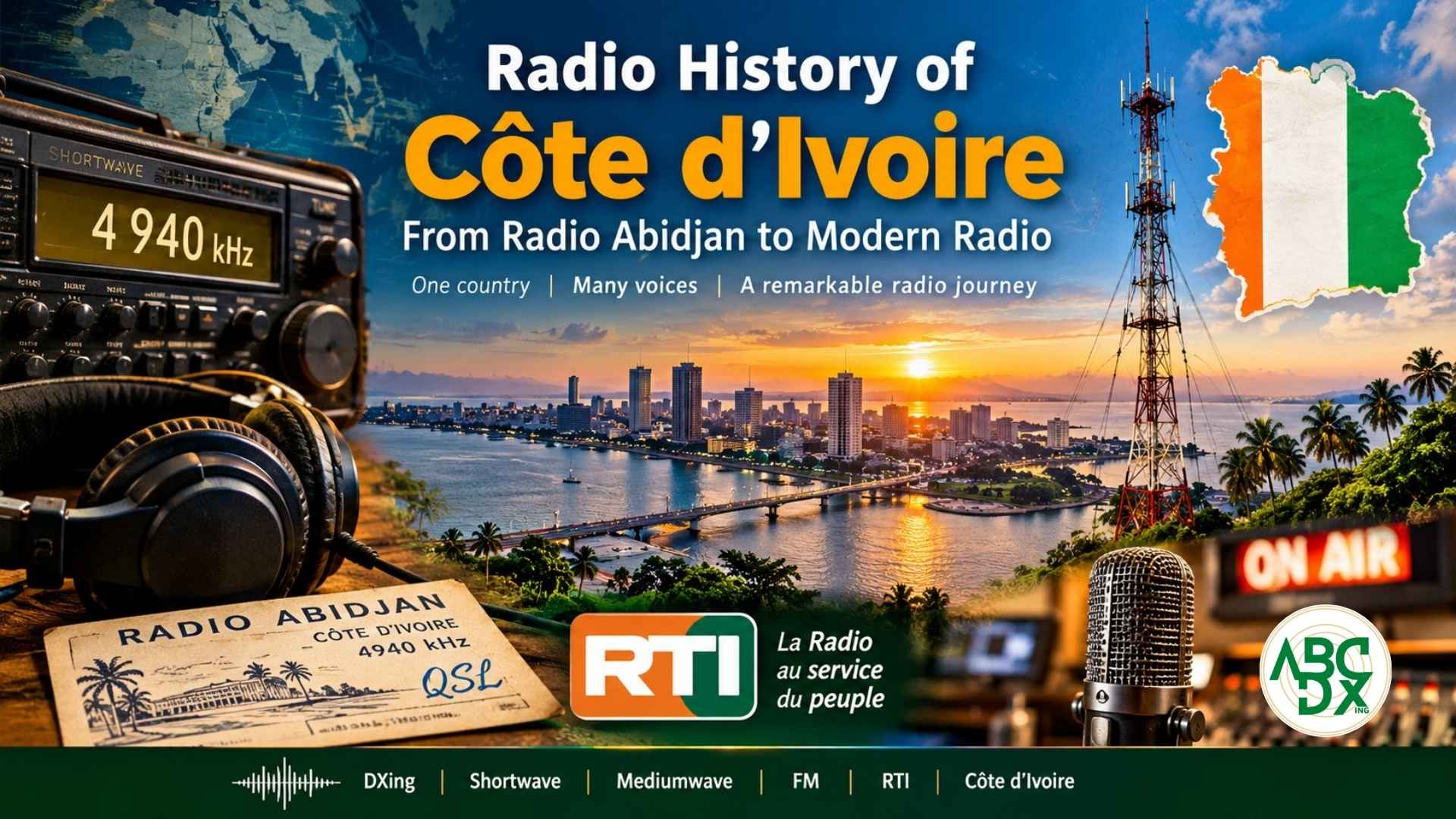

Côte d’Ivoire has always carried a special sound for the shortwave listener. During the great era of African shortwave broadcasting, the name Radio Abidjan appeared regularly in DX logs and frequency guides. Its signals were heard far beyond West Africa, particularly on the tropical bands, where 4940 kHz became one of its best-known frequencies. What began with a modest transmitter in Abidjan eventually developed into a much larger national broadcasting system, with powerful shortwave transmitters, mediumwave services and, later, an extensive FM network. For a DXer, however, the radio history of Côte d’Ivoire is not simply the history of a broadcasting organisation. It is the story of signals that once travelled thousands of kilometres from West Africa into the headphones of listeners around the world.
Côte d’Ivoire: The Country Behind the Signal
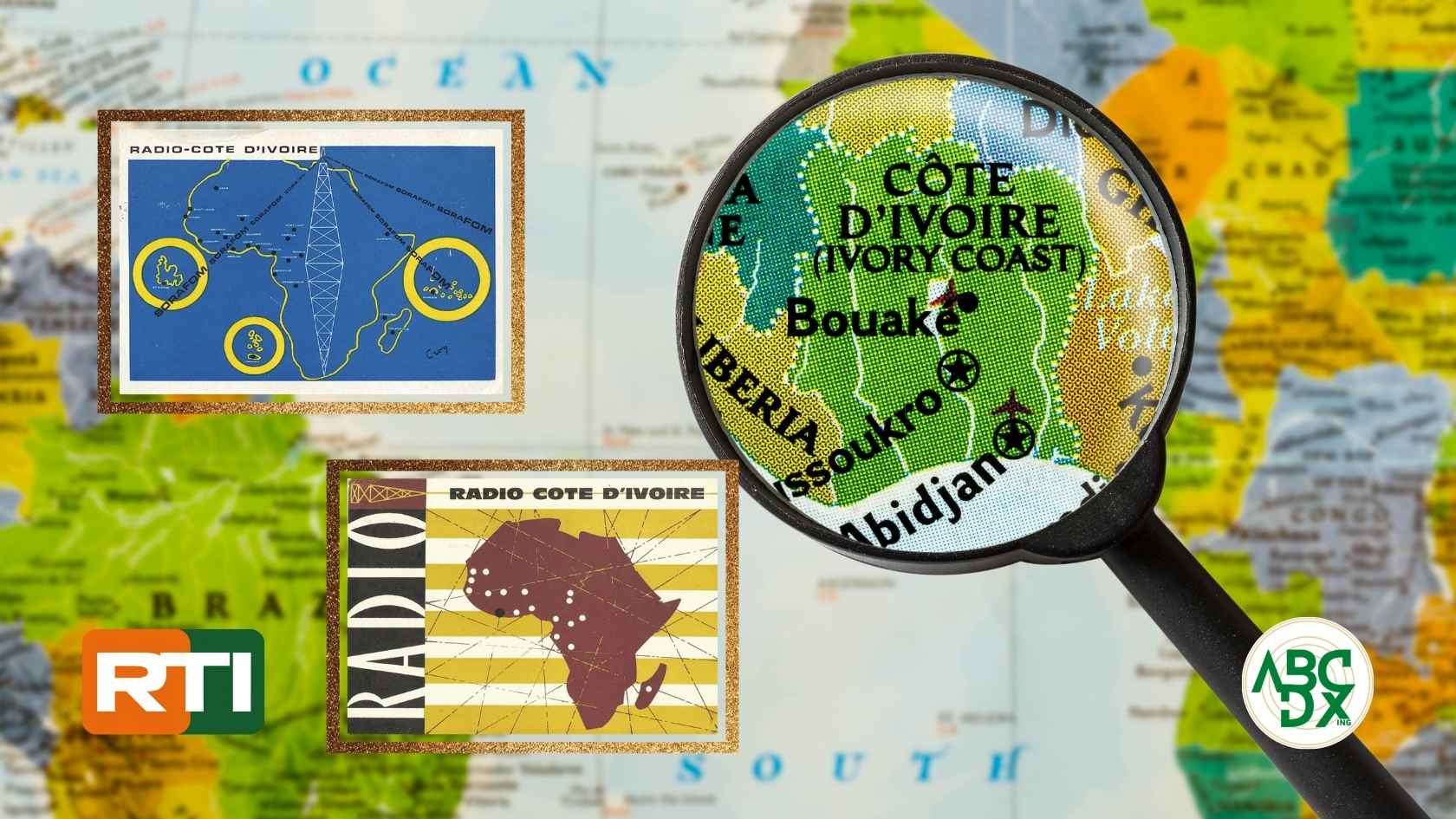
Côte d’Ivoire, officially the Republic of Côte d’Ivoire, occupies an important position on the southern coast of West Africa. It faces the Gulf of Guinea and shares borders with Liberia and Guinea to the west, Mali and Burkina Faso to the north, and Ghana to the east. The country covers approximately 322,463 square kilometres, with Yamoussoukro as its political capital and Abidjan as its principal economic and media centre. The official language is French, although Côte d’Ivoire has a rich multilingual landscape with numerous African languages used in everyday life.
The country is also one of the most culturally and religiously diverse in the region. The Ivorian government's current country profile gives a 2025 population of about 32 million, with Islam and Christianity forming the two largest religious traditions, alongside traditional beliefs and people reporting no religious affiliation. Among the major national languages are Baoulé, Dioula, Sénoufo, Malinké, Agni and Yacouba, among many others. Recent national statistical data confirms the continuing importance of these languages in both urban and rural communities. For a DXer, one geographical fact is particularly useful. Côte d’Ivoire operates on Greenwich Mean Time, UTC+00:00, throughout the year and does not observe daylight saving time. Therefore, a broadcast listed at 1800 UTC is also heard at 1800 local time in Abidjan, Bouaké, Yamoussoukro or elsewhere in the country.
Before Radio: The Foundations of Communication
The history of radio communication in Côte d’Ivoire began before broadcasting itself. During the colonial period, telegraph and telephone networks were gradually established to connect administrative centres, ports and commercial settlements. These early systems were the foundations upon which later radio communication would develop.
Abidjan and the coastal region naturally became the centre of this development. As the country's administrative and economic importance grew, so did the need for faster communication over longer distances. Wired telegraphy and telephony could provide important links, but radio offered something fundamentally different. A radio link did not require a physical cable between transmitter and receiver. It could cross difficult terrain and eventually reach places that conventional communication networks could not easily serve. The development of radio-electric communication therefore became an important part of Côte d’Ivoire's wider communications infrastructure. Long before a listener could tune to Radio Abidjan, engineers were already learning how electromagnetic waves could connect the country with the outside world.
1949: The First Radio Experiments in Côte d’Ivoire
The beginning of broadcasting in Côte d’Ivoire is generally traced to 1949, when the first experimental radio programmes were transmitted from Abidjan. Historical accounts of RTI describe these first broadcasts as the beginning of the country's broadcasting service. At this stage, however, there was nothing resembling the large national network that would eventually emerge.
The equipment was modest, the studio facilities were limited and broadcasting hours were short. Yet technically, the basic principle was already established: programme audio was generated in a studio, converted into a radio-frequency signal and radiated through an antenna for listeners to receive.
For the engineers involved, this was a significant beginning. For the future DXer, it was the first step toward a signal that would eventually escape the boundaries of Abidjan and travel across oceans.
1951: Radio Abidjan Appears
A more clearly defined broadcasting service emerged on 8 February 1951, when the radio was officially known as Radio Abidjan. According to historical accounts, the station operated with a transmitter of approximately 1 kW. RTI's history and independent broadcasting references both distinguish this 1951 Radio Abidjan service from the earlier experimental broadcasts of 1949.
A 1 kW transmitter may sound tiny compared with the transmitters used by major international broadcasters today. In the early 1950s, however, it was enough to establish a genuine broadcasting service. The initial operation was primarily associated with mediumwave, but Radio Abidjan soon entered the shortwave bands.
That decision would eventually make the station famous among international listeners.
Radio Abidjan Takes to Shortwave
Historical shortwave records place Radio Abidjan on shortwave by 1952, using approximately 1 kW or less. The transmitter power subsequently increased, first to around 5 kW and then to approximately 10 kW by about 1955. Radio Heritage's historical account specifically identifies 4940 kHz as the frequency on which the station eventually became widely heard.
The importance of this development cannot be overstated from a DXer's point of view. Shortwave changed the geographical reach of Radio Abidjan. A mediumwave signal was primarily intended for domestic audiences, while shortwave could use ionospheric propagation to reach listeners much farther away.
That made Radio Abidjan part of the international shortwave listening world.
The famous 60-metre band became particularly associated with the station. When propagation conditions were favourable, the signal could travel enormous distances. For listeners thousands of kilometres from West Africa, the appearance of a French-speaking African voice around 4940 kHz could be the beginning of a memorable DX catch.
4940 kHz: Côte d’Ivoire Radio Remembered by DXers
Among the many frequencies that have appeared in the history of African broadcasting, 4940 kHz deserves special attention. Radio Abidjan eventually settled on this frequency in the tropical-band era, and historical DX material records it as a widely heard channel. Radio Heritage even notes its usefulness to listeners on the east coast of North America, where it could be among the early African signals to appear during the afternoon under suitable propagation conditions.
There was nothing predictable about tropical-band reception. Atmospheric noise could cover the signal completely. Another station might occupy the same or a nearby channel. Propagation could change rapidly with sunset, season and solar conditions. An antenna that produced a strong signal one evening might produce almost nothing the next.
That uncertainty was part of the fascination.
The DXer listened through the noise, adjusted the tuning and waited for the identification. When the words Radio Abidjan finally emerged from the static, the distance between West Africa and the listening room suddenly seemed much smaller.
From Radio Abidjan to Radio Côte d’Ivoire
Côte d’Ivoire became independent from France on 7 August 1960. At independence, the country had essentially one principal broadcasting station, Radio Abidjan. The new nation now needed a broadcasting service capable of serving a much wider national audience.
Around this period, the station became known as Radio Côte d’Ivoire. The change reflected a broader ambition. Broadcasting was no longer simply a service based in Abidjan. It was becoming a national communication network designed to connect different parts of the country and strengthen the flow of information across the new republic. RTI's historical material confirms the transition from Radio Abidjan to Radio Côte d’Ivoire in 1961.
The technical challenge was considerable. Côte d’Ivoire was geographically large, and its population was spread across very different regions. A national broadcaster therefore needed more than a powerful transmitter in Abidjan. It required a network of transmission facilities and programme distribution links.
Radio was becoming infrastructure.
1962: RTI in Côte d’Ivoire Radio History

A major institutional milestone followed on 31 October 1962, when the Ivorian government established the Radiodiffusion Télévision Ivoirienne, universally known as RTI. At this stage, the organisation was responsible for radio broadcasting; television followed with its first broadcasts in 1963.
RTI's mission extended beyond entertainment. Broadcasting was expected to inform and educate as well as entertain. That mission shaped the development of the national radio service, particularly its news programmes, educational broadcasts, cultural programming and use of national languages.
The creation of RTI also marked the beginning of a more structured technical era. Studio facilities, transmitters, relay stations and programme-distribution systems could now be developed as components of a national broadcasting network rather than as isolated facilities.
The Shortwave Radio Network in Côte d’Ivoire
During the 1960s and 1970s, Côte d’Ivoire developed a much more substantial radio transmission system. The technical scale reached far beyond the modest 1 kW Radio Abidjan transmitter of the early 1950s.
A 1975 UNESCO communications reference provides an especially valuable snapshot of the system. It records the RTI national network with mediumwave transmitters of 4 kW at Abidjan and 5 kW at Bouaké, together with 25 kW and 100 kW shortwave transmitters at Abidjan. The same source records an international service with one 1 kW mediumwave transmitter and 10 kW and 100 kW shortwave transmitters.
Those figures tell an important story.
Côte d’Ivoire was no longer operating a small local radio station. It had developed a substantial broadcasting operation with transmitters powerful enough to carry its programmes far beyond the country's borders.
The same 1975 source reported that radio coverage reached about 80 percent of the country. The national network broadcast in French and in ten vernacular languages, while educational programmes included broadcasts intended for schools and teacher-training purposes.
For a radio engineer, this was an impressive evolution. For a DXer, it meant more opportunities to hear Côte d’Ivoire on shortwave.
11920 kHz: Côte d’Ivoire radio in International Dimension
During the 1970s, 11920 kHz became another important frequency associated with Côte d’Ivoire. Historical DX material records the station on this higher shortwave channel, giving international listeners another route to the Ivorian signal.
Higher shortwave frequencies behave differently from the lower tropical bands. Their usefulness depends strongly on propagation conditions, time of day, season and solar activity. That is why experienced DXers never judged a station simply by its transmitter power.
A 100-kW transmitter does not guarantee a strong signal everywhere. The ionosphere remains part of the circuit.
For the listener, this meant that Côte d’Ivoire could sometimes arrive with impressive strength and at other times disappear beneath noise and fading. The changing signal was not a defect in the transmitter. It was the nature of shortwave propagation.
Radio and the Languages of Côte d’Ivoire
Language has always been an important part of Ivorian radio history. French became the official language of the state, but the country has a large number of national languages. A truly national broadcasting service therefore had to reach audiences beyond French-speaking urban centres.
The historical 1975 broadcasting record is particularly useful here because it confirms programming in French and ten vernacular languages. Modern national data likewise demonstrates the continuing importance of languages such as Baoulé, Dioula, Sénoufo, Malinké, Agni and Yacouba.
From a technical standpoint, the transmitter did not care which language was being spoken. The microphone converted speech into an electrical audio signal, the studio equipment processed it, and the transmitter placed that information onto a radio-frequency carrier.
For the listener, however, the language made all the difference.
A French news bulletin might identify the station to an international DXer. A programme in a national language could make the same transmitter immediately meaningful to a listener inside Côte d’Ivoire.
Radio was therefore doing two jobs at once. It was connecting the country with the outside world while also connecting communities within the country.
The Arrival of FM Radio in Côte d’Ivoire
While shortwave and mediumwave remained important, another technology was beginning to change broadcasting: frequency modulation, or FM.
By the 1970s, experimental FM broadcasts were already being carried out from several locations, including Abidjan, Bouaflé, Man and Koun-Abroussou. The 1975 UNESCO reference specifically records these experimental FM operations.
FM offered a different technical proposition from shortwave. It was not designed primarily for intercontinental communication. Instead, it was ideal for local and regional broadcasting where good audio quality and relatively stable reception were more important than enormous geographical reach.
The difference can be expressed simply.
Shortwave was excellent for distance. FM was excellent for locality. That distinction would become increasingly important during the following decades.
Fréquence 2 and a New Radio Sound
The Ivorian public radio system eventually expanded beyond its original general-service structure. Fréquence 2, RTI's second radio channel, was launched in 1983, adding a more entertainment-oriented service to the public broadcasting landscape. Sources describing the development of the Ivorian media system identify Fréquence 2 as one of the later public radio services alongside Radio Côte d’Ivoire.
This was an important step in the evolution of radio audiences.
A national radio service could concentrate heavily on news, public information and national affairs. A second channel could experiment more freely with music, entertainment and programmes aimed at younger listeners.
The radio receiver was becoming a more personal device.
Instead of simply listening to whatever the national broadcaster transmitted, audiences increasingly had choices.
The End of the Radio Monopoly
The political and media environment of Côte d’Ivoire changed considerably from the late 1980s into the 1990s. The introduction of multiparty politics and broader media pluralism created the conditions for a much more diverse radio broadcasting environment. A media landscape study notes that RTI and other state media had been the principal sources of information until the arrival of the multiparty era around 1990, after which the number of media outlets expanded significantly.
Radio was part of that transformation.
Private broadcasters began to appear, followed by community, religious and other specialised services. The FM band became increasingly important because a relatively modest transmitter could serve a city or region without the enormous infrastructure required for national shortwave coverage.
This was the beginning of the modern Côte d’Ivoire radio landscape history.
From One National Voice to Many
The change was dramatic when viewed against the early years.
In the Radio Abidjan era, the country had one principal broadcasting service. Later, RTI created additional channels and expanded its network. Eventually, private and community broadcasters added entirely new voices to the dial.
Commercial radio brought different programme formats and music styles.
Religious broadcasters created dedicated audiences.
Community stations concentrated on local issues.
International broadcasters found new ways to reach Ivorian listeners.
The radio dial was becoming more diverse, and the listener had more control over what to hear.
For DXers, this also changed the nature of the hobby. The old challenge had been finding a distant Ivorian signal on shortwave. Increasingly, the challenge became understanding a dense local FM landscape.
The Decline of Ivorian Shortwave
The golden age of Côte d’Ivoire on shortwave could not last forever.
As FM networks expanded, the economics of domestic broadcasting changed. Local FM transmitters were better suited to city and regional audiences, while satellite distribution and other programme-delivery technologies made it easier to feed geographically separated transmitters.
Shortwave remained technically capable of covering enormous distances, but that very strength was no longer essential for most domestic broadcasting needs.
Radio Heritage records Radio Abidjan's shortwave service as ending around 2001. The historical record is not perfectly uniform, and later DX references may show irregular or residual transmissions. For that reason, the safest interpretation is that the early-2000s period marks the end of the long-running shortwave era rather than an instant disappearance from every possible shortwave transmission.
For older shortwave listeners, the disappearance was significant. One more African signal had left the bands.
What the Loss of Shortwave
A modern listener can hear an Ivorian radio station almost instantly through streaming or digital platforms. The sound can be clean and stable, with no fading and almost no atmospheric interference.
Shortwave offered something very different.
The signal could rise and fall.
A thunderstorm could introduce noise.
Another station could appear underneath it.
Propagation could change within minutes.
A DXer might spend several evenings trying to identify a station before finally hearing the call sign clearly.
That effort created a relationship between listener and transmitter that is difficult to reproduce with an internet stream.
Radio Abidjan was not simply something you listened to.
It was something you found.
Radio Through a Changing Nation
The importance of radio did not disappear with the decline of shortwave. During the political and social changes of the late twentieth and early twenty-first centuries, radio remained an accessible medium for news, information, entertainment and community communication.
The public broadcaster continued to operate national services, while private and community stations expanded the number of voices available to listeners.
This development also reinforced the value of local broadcasting.
A powerful shortwave transmitter could cover a continent, but a small FM transmitter could speak directly to a particular city or community. That local connection became one of the defining characteristics of modern Ivorian radio.
The technology had become less about crossing oceans and more about serving people nearby.
The Modern Radio Landscape
Today's radio environment in Côte d’Ivoire is vastly more diverse than the one that existed when Radio Abidjan began.
RTI remains a major public broadcasting institution, with Radio Côte d’Ivoire and Fréquence 2 forming important parts of its radio operation. Alongside them are commercial, community, religious, educational and other specialised broadcasters.
The scale of the modern system is remarkable. Côte d’Ivoire's audiovisual regulator, the Haute Autorité de la Communication Audiovisuelle, or HACA, reported 322 authorised radio services at the end of 2024. Its 2024 activity report also recorded 297 FM radio services with 433 assigned frequencies as of July 2024.
That is a remarkable contrast with the single principal broadcasting service of the early independence era.
The country now has a radio ecosystem rather than simply a national radio station.
International Radio Comes to the FM Dial
There is another fascinating change from the perspective of broadcasting history.
During the shortwave era, an Ivorian listener who wanted to hear an international broadcaster might have searched the shortwave bands. Today, international broadcasters can themselves be part of the local FM environment.
HACA's operator directory includes services associated with international broadcasters such as BBC, RFI, VOA, Medi 1 and Africa Radio, alongside Ivorian public, commercial, community and religious services.
This represents a complete reversal of the old listening geography.
The international signal no longer necessarily needs to travel thousands of kilometres through the ionosphere to reach an Ivorian listener.
It may arrive through a local FM transmitter.
The technology changed, but the purpose remained familiar: connecting listeners with information and ideas from beyond their immediate surroundings.

Are you searcing for an Antenna
Whether you are hunting for low-power community stations or "clear channel" giants from across the continent, building your own antenna is the first step toward mastering the airwaves. It is a bridge between the craftsmanship of the past and the technical curiosity of the future. Here is the step-by-step guide on how to build an MW Antenna for DXing.
From Analogue Transmitters to Digital Distribution
Modern radio engineering has also transformed behind the scenes.
The classic broadcasting chain remains fundamentally recognizable. A microphone captures the presenter or performer, studio equipment processes the audio, a transmitter converts the programme into a radio-frequency signal, and an antenna radiates the signal into space.
What has changed is everything surrounding that basic chain.
Programme material can now be stored digitally, transported through computer networks, distributed by satellite and delivered simultaneously to multiple transmitters. Broadcasters can also provide streaming, podcasts and other online services alongside conventional terrestrial transmission.
RTI itself has moved into this environment. Its radio services are no longer restricted to traditional terrestrial reception, and the organisation has developed internet-based distribution as part of its modern broadcasting operation.
The transmitter is still there. But it is no longer the only doorway to the listener.
Radio Communication Beyond Broadcasting
The wider history of radio communication in Côte d’Ivoire is now much larger than broadcasting.
The radio spectrum supports mobile communication, microwave links, satellite services, navigation, public and private communication systems, broadcasting and many other applications. Modern telecommunications therefore involve a much more complex frequency environment than the engineers of Radio Abidjan could have imagined in 1951.
From the viewpoint of a radio technician, this is perhaps the most striking part of the story.
The basic electromagnetic principle has not changed.
Only the applications have multiplied.
A single radio spectrum now carries an enormous variety of information, from a voice programme on FM to a digital data connection travelling through a modern communications network.
Côte d’Ivoire Through the DXer's Headphones
For those who discovered Côte d’Ivoire through shortwave, however, the old frequencies will always have a special place.
There was something unforgettable about searching the tropical bands and finding a faint African voice buried beneath static. Perhaps the signal would be strong enough to identify immediately. Perhaps only a few words would survive the fading.
Then came the moment of confirmation.
Radio Abidjan.
The words could transform a noisy frequency into a geographical experience.
Suddenly, the listener was no longer simply hearing a radio signal. The mind travelled to Abidjan, to the Gulf of Guinea, to the streets and communities behind the transmission.
That is one of the reasons old shortwave stations remain so important to DXers.
They were not merely transmitters.
They were windows.
From 1 kW to a Nation of Radio Stations
The technical journey of the history of Côte d’Ivoire radio is extraordinary when viewed as a single timeline.
The first experimental broadcasts appeared in 1949. Radio Abidjan followed as an established service in 1951, initially with a transmitter of around 1 kW. Within a few years, shortwave power had increased and the station had become a familiar tropical-band signal, particularly around 4940 kHz.
After independence, Radio Abidjan became Radio Côte d’Ivoire and developed into a national broadcasting service. RTI was established in 1962, while the following decades brought more powerful transmitters, wider national coverage, experimental FM and additional public radio services.
The later transformation was just as dramatic.
FM replaced much of the practical role once played by shortwave for domestic coverage. Private and community broadcasting expanded. International broadcasters appeared through local distribution arrangements. Digital platforms added another layer to the listening experience.
From one small transmitter to hundreds of authorised radio services, the scale of change is difficult to ignore.
The Voice Remains
The shortwave era of Côte d’Ivoire may now belong largely to broadcasting history, but the story that began with Radio Abidjan continues.
Today's listener encounters a very different radio landscape. There are public broadcasters, commercial stations, community services, religious broadcasters, international services and digital platforms. The familiar sound of a shortwave signal fighting its way through atmospheric noise has largely disappeared from the Ivorian broadcasting scene.
Yet the fundamental idea remains exactly the same.
Someone speaks.
A microphone captures the voice.
Electronics transform it into a signal.
A transmitter sends it into the electromagnetic world.
And somewhere, someone listens.
That is the thread connecting the experimental broadcasts of 1949 with the hundreds of radio services operating in Côte d’Ivoire today.
Remembering Radio Abidjan
For today's generation, 4940 kHz or the history Radio Côte d’Ivoire may be nothing more than an old frequency or radio in a DX archive.
For an older generation of listeners, it represents something much more personal.
It was the:
- sound of West Africa arriving through the static.
- excitement of identifying a distant station.
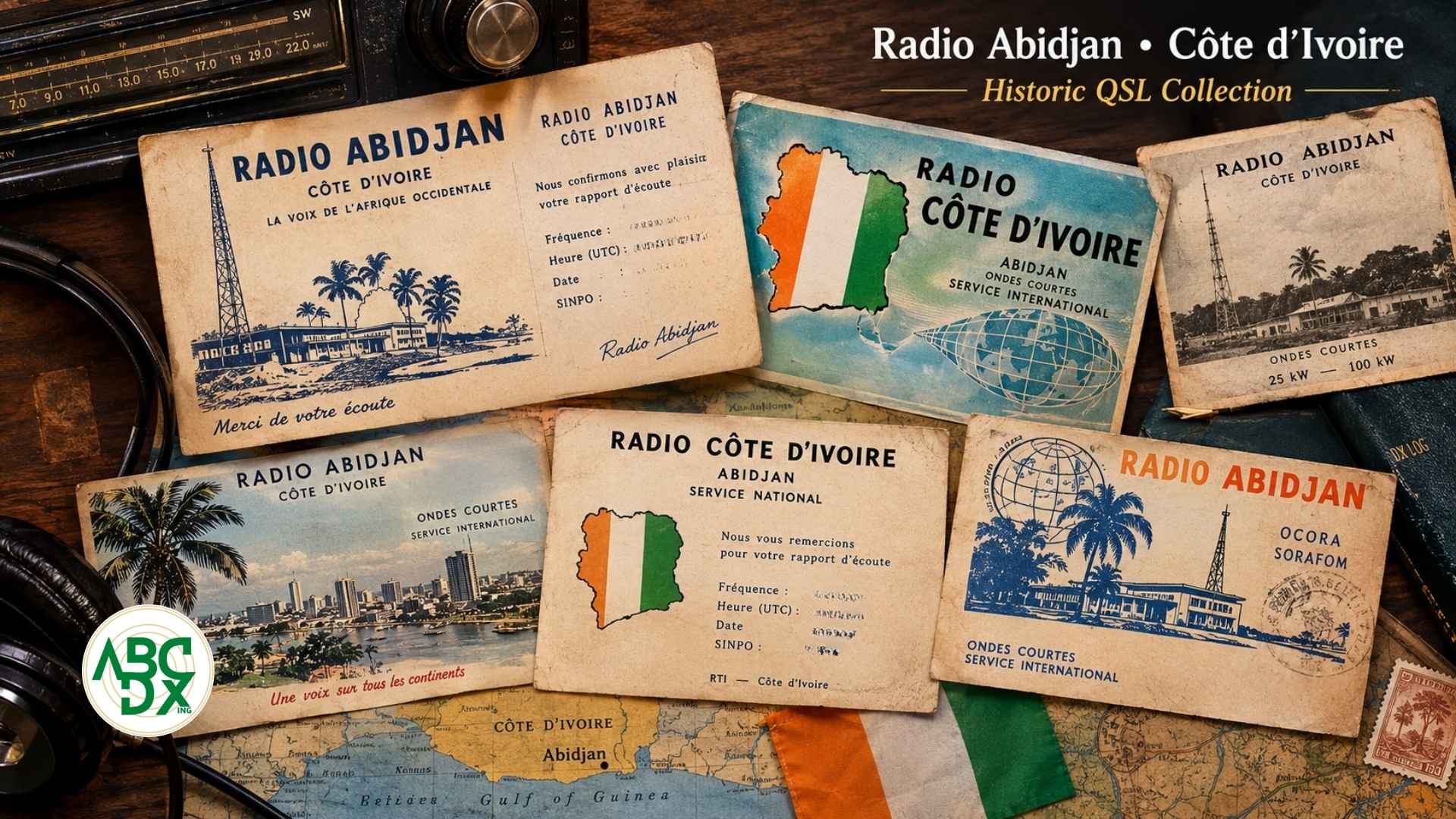
- search for a QSL card.
- careful comparison of frequencies and schedules. And
It was the knowledge that a relatively small piece of equipment in a listener's room could receive a signal from another part of the world.
Radio Abidjan belonged to that remarkable generation of African stations that made the shortwave bands feel like a map of the planet.
Côte d’Ivoire was not merely a country on that map.
It was a voice.
A Radio Journey Across Côte d’Ivoire
The history of radio in Côte d’Ivoire is therefore a story of continuous transformation.
It began with the foundations of wired communication and early radio experiments. It moved into the broadcasting era with Radio Abidjan, crossed national boundaries through shortwave, expanded through Radio Côte d’Ivoire and RTI, and eventually embraced FM, private broadcasting and digital distribution.
The old shortwave transmitters may have fallen silent, may in history, but the radio spectrum of Côte d’Ivoire has never stopped evolving.
For the DXer, that is perhaps the most satisfying conclusion.
- Station disappears
- Frequency changes
- Transmitter is replaced, and
- New technology arrives.
Yet radio continues to connect people across distance.
And somewhere in the history of every modern Ivorian FM signal is the memory of a much older transmitter in Abidjan, sending the first sounds of Radio Abidjan into the West African night.
For those who remember the tropical bands, 4940 kHz will always be more than a frequency. It is part of the sound of Côte d’Ivoire.
References and Further Reading
This article has been researched from a combination of historical broadcasting records, DX-oriented sources, institutional information and communications references.
Particular attention was given to:
- RTI's historical record concerning the first broadcasts in 1949, the establishment of Radio Abidjan in 1951 and the creation of RTI in 1962;
- Radio Heritage's historical documentation of Radio Abidjan's shortwave operation, including its well-known 4940 kHz and later 11920 kHz transmissions; the UNESCO World Communications reference of 1975 for contemporary transmitter powers, coverage and broadcasting facilities; and
- the Haute Autorité de la Communication Audiovisuelle (HACA) for the present-day Ivorian radio landscape, including authorised stations and FM frequency assignments.
Readers interested in exploring the Radio history of Côte d’Ivoire further may consult these sources directly:
- RTI historical information via Africultures,
- Radio Heritage's historical shortwave records,
- UNESCO World Communications 1975 reference, and
- HACA's current radio operator directory.
These sources also illustrate an important point for radio historians: historical frequency schedules and transmitter records can vary between periods and publications, so individual frequencies and dates should always be considered within their historical context.