
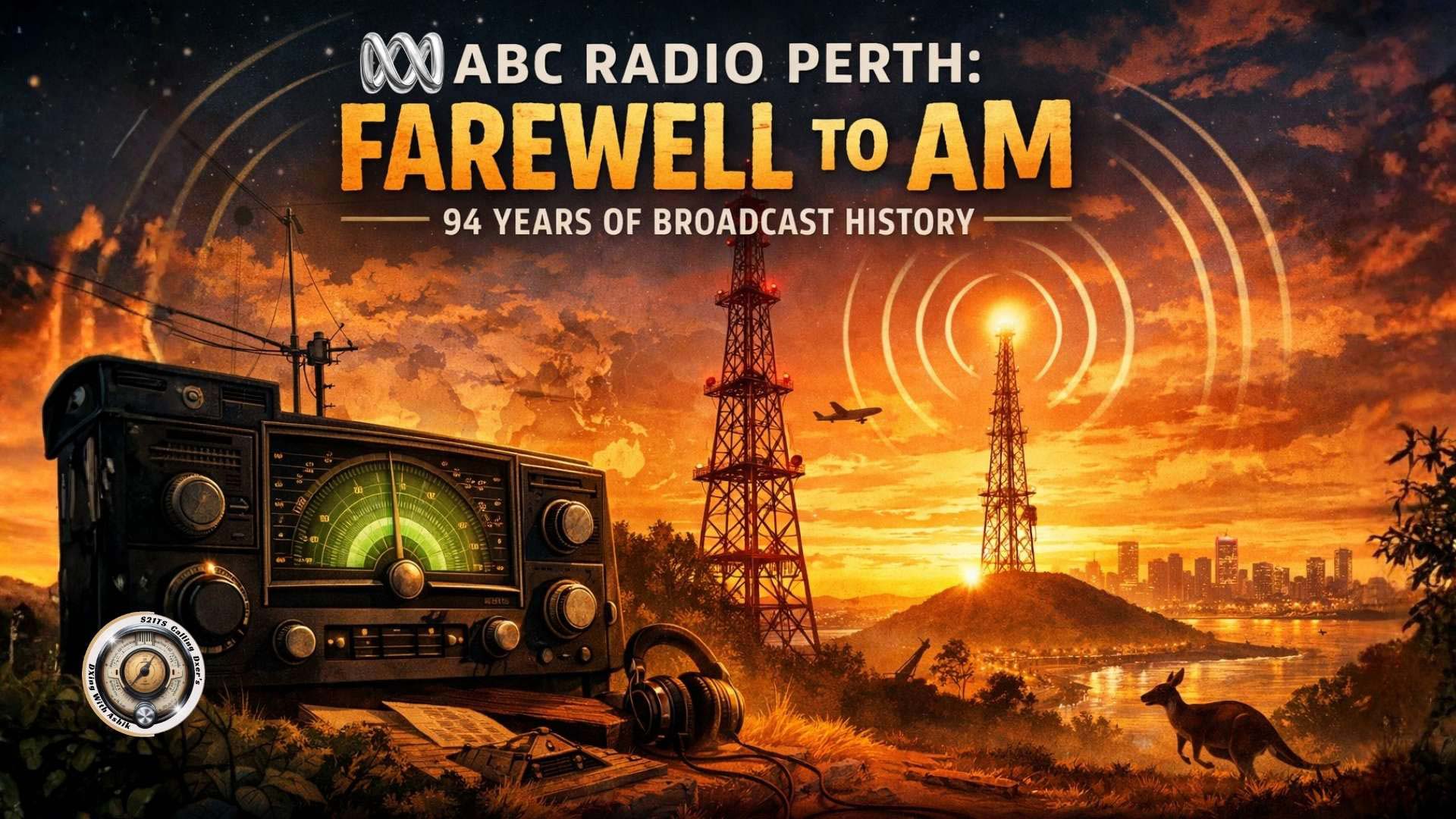

For lifelong DXers, band changes always feel personal. This month, Perth witnessed the end of a remarkable chapter. After 94 years, ABC’s historic AM transmission, ABC Radio Perth leaves AM. The move marked the closure of the Hamersley AM transmitter era.
A Historic Shift by the ABC
The Australian Broadcasting Corporation transitioned its Perth services from AM to FM. The change officially occurred on February 23. Starting Monday, 6 April 2026, ABC Perth and ABC Radio National will no longer be available on AM in Perth. However, the ABC NewsRadio will still be accessible through its AM service, as well as FM.
Three major services shifted frequencies.
1. ABC Radio Perth moved to 102.5 FM.
2. ABC Radio National moved to 103.3 FM.
3. ABC NewsRadio moved to 104.1 FM.
For local listeners, the change improves clarity and reception. For DXers, it closes a powerful medium-wave target.
The Hamersley Transmitter: A 94-Year Legacy
The Hamersley AM site served Western Australia since 1930. Its signal carried news, emergencies, and cultural programming across vast distances.
At night, medium-wave propagation extended far beyond Perth. Under favorable conditions, regional listeners and rare DX catches were possible. For enthusiasts in Asia, Australia’s west coast was always intriguing. Long-path and grey-line openings occasionally delivered surprises. Hamersley’s mast symbolized endurance in analog broadcasting history. Its shutdown ends nearly a century of continuous AM heritage.
Why ABC Radio Perth Leaves AM to FM?
FM provides clearer audio and reduced interference. Urban electrical noise increasingly affects AM reception quality. Industry analyst James Cridland highlighted accessibility concerns. Emergency broadcasting must reach the largest possible audience.
FM radios dominate cars and portable receivers today. Clearer in-car reception significantly boosts listenership.
Globally, similar transitions are accelerating. Japan and parts of the United States are reducing AM dependence. The trend reflects evolving listening habits and spectrum priorities.
The New Transmission Site: Bickley
The FM signals originate from Bickley in the Perth Hills. BAI Communications prepared the upgraded FM mast. The elevated site enhances metropolitan coverage. Terrain advantages improve signal penetration across suburbs. While AM traveled farther, FM ensures stronger local reliability. Emergency resilience remains a key public broadcasting priority.
What This Closer Means for DXers
For medium-wave DXers, one more classic signal disappears. Australia’s AM band grows quieter each year. Perth was never easy from South Asia. However, rare catches rewarded patience and precise tuning.
FM signals rarely offer long-distance skywave opportunities. Tropospheric ducting remains the only realistic exception. The closure reduces transoceanic medium-wave diversity. Another distinctive carrier fades into memory.
The Broader Context of AM’s Decline
AM once defined global broadcasting. It carried wartime bulletins and peacetime culture. Today, digital platforms and FM dominate urban markets. Operational costs for AM infrastructure remain high. Maintenance of aging transmitters becomes increasingly uneconomical. Environmental and power considerations also influence decisions.
Yet AM still serves remote regions worldwide. In disaster scenarios, its groundwave coverage remains valuable. The Perth decision reflects local priorities, not universal abandonment.
Final Reflections from a DXer
For those who grew up tuning medium-wave dials, this feels historic. Each silent carrier holds memories of distant voices. The Hamersley transmitter served Western Australia for nearly a century. Its silence marks progress and nostalgia simultaneously. Radio evolves, yet passion remains constant. DXing continues, even as bands transform. The spirit of listening survives every frequency change.